
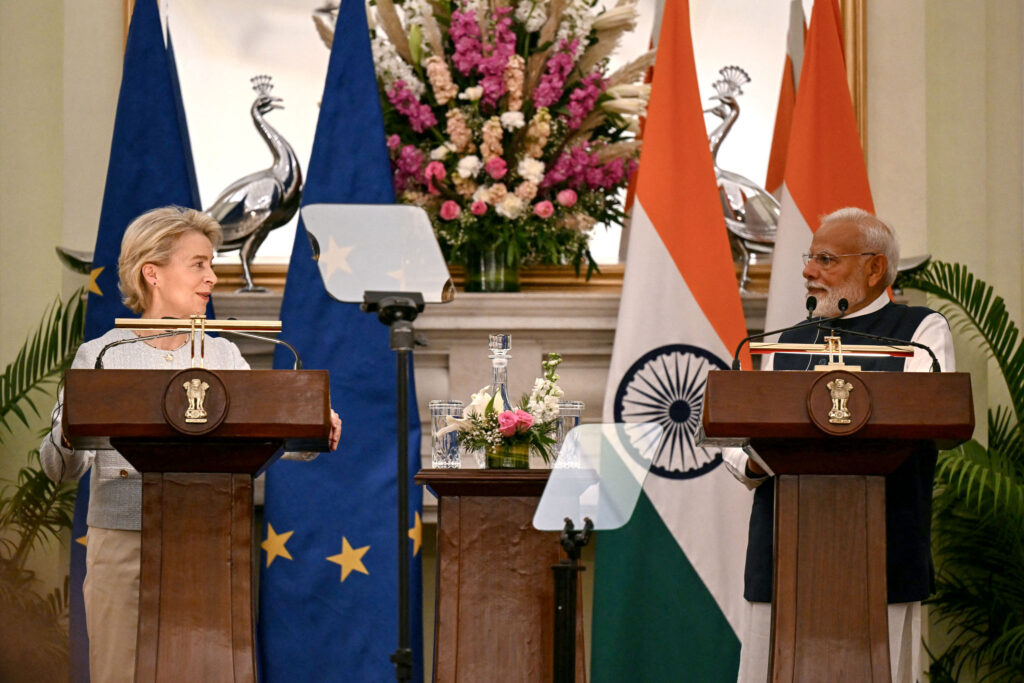
In a landmark moment for global geopolitics, India and the European Union have signed their first-ever Comprehensive Defence and Security Partnership, marking a decisive shift in bilateral relations from economic cooperation to deep strategic engagement. The agreement reflects growing convergence between New Delhi and Brussels on security challenges, geopolitical stability, and the need for trusted partnerships in an increasingly uncertain world.
This historic pact elevates India–EU ties to a new strategic level, covering defence cooperation, maritime security, cyber threats, counter-terrorism, space security, and emerging technologies.
A Strategic Breakthrough in India–EU Relations
Until now, India–EU relations have largely focused on:
- Trade and investment
- Climate action and sustainability
- Digital cooperation
- Multilateral diplomacy
The signing of a comprehensive defence and security partnership represents a clear recognition that economic cooperation alone is no longer sufficient in today’s geopolitical environment.
The partnership signals:
- Mutual trust
- Shared strategic interests
- Long-term commitment to global stability
Why This Partnership Matters Now
A Changing Global Security Landscape
The agreement comes at a time when the world faces:
- Heightened geopolitical rivalries
- Ongoing regional conflicts
- Disruptions to global supply chains
- Cyber warfare and hybrid threats
Both India and the EU recognise that security challenges are increasingly transnational, requiring cooperation beyond traditional alliances.
Convergence of Strategic Interests
India and the EU share common concerns about:
- Freedom of navigation
- Rule-based international order
- Countering terrorism and extremism
- Resilience against cyber and space threats
The partnership reflects this growing strategic alignment.
What Is a Comprehensive Defence and Security Partnership?
The agreement is designed as a multi-dimensional security framework, covering both traditional and non-traditional threats.
Key Pillars of the Partnership
The partnership focuses on:
- Defence dialogue and cooperation
- Maritime security
- Cybersecurity and cyber resilience
- Counter-terrorism
- Space security
- Defence industry collaboration
- Crisis management and peacekeeping
This broad scope makes it the most ambitious security framework India has signed with the EU to date.
Defence Cooperation: From Dialogue to Action
Institutionalised Defence Dialogue
The partnership establishes:
- Regular high-level defence consultations
- Strategic military-to-military exchanges
- Structured policy coordination
This institutionalisation ensures continuity and long-term cooperation rather than ad-hoc engagement.
Training and Capacity Building
India and the EU will explore cooperation in:
- Military training programs
- Professional exchanges
- Peacekeeping operations
India’s extensive experience in UN peacekeeping and the EU’s crisis management capabilities create natural synergy.
Maritime Security: A Shared Priority
Focus on the Indo-Pacific
Maritime security is a central pillar of the agreement, reflecting shared interest in:
- Freedom of navigation
- Secure sea lanes
- International maritime law
The partnership strengthens cooperation in the Indo-Pacific, a region critical to global trade and stability.
Naval Cooperation and Information Sharing
The agreement supports:
- Enhanced maritime domain awareness
- Information sharing on maritime threats
- Coordinated responses to piracy and illegal activities
This contributes to safer and more resilient global maritime commons.
Cybersecurity and Emerging Threats
Addressing Cyber and Hybrid Warfare
Cyber threats are among the fastest-growing security risks. The partnership focuses on:
- Cyber resilience
- Protection of critical infrastructure
- Sharing best practices and threat intelligence
This cooperation is crucial as both India and the EU face increasing cyberattacks on government and commercial systems.
Countering Disinformation
The agreement also recognises the threat posed by:
- Disinformation campaigns
- Hybrid warfare tactics
By sharing expertise and policy tools, India and the EU aim to strengthen democratic resilience.
Counter-Terrorism Cooperation
Tackling a Global Threat
Terrorism remains a shared concern. The partnership enhances cooperation through:
- Intelligence sharing
- Capacity building
- Joint efforts to combat radicalisation
India’s long-standing experience in counter-terrorism and the EU’s institutional mechanisms complement each other.
Financing and Networks
The agreement also focuses on:
- Disrupting terror financing
- Monitoring cross-border networks
This strengthens collective ability to address terrorism at its roots.
Space Security and Emerging Technologies
Space as a New Security Domain
With increasing reliance on satellites for:
- Communication
- Navigation
- Defence
space security has become critical. The partnership includes dialogue on:
- Responsible behaviour in outer space
- Protection of space-based assets
Cooperation in Emerging Technologies
India and the EU will explore collaboration in:
- Artificial intelligence
- Quantum technologies
- Advanced defence systems
This positions the partnership as future-oriented rather than reactive.
Defence Industry and Technology Collaboration
Industrial Cooperation
The agreement opens avenues for:
- Joint research and development
- Defence industrial partnerships
- Technology transfer
This aligns with India’s goal of strengthening indigenous defence manufacturing.
Supply Chain Resilience
By working together, India and the EU aim to:
- Reduce dependence on limited suppliers
- Build resilient defence supply chains
This has both economic and strategic benefits.
Strategic and Geopolitical Implications
Strengthening a Rules-Based Order
The partnership reinforces commitment to:
- International law
- Multilateral institutions
- Peaceful resolution of disputes
It sends a strong signal in support of a stable global order.
Diversifying Strategic Partnerships
For India, the agreement:
- Expands strategic engagement beyond traditional partners
- Enhances its global diplomatic footprint
For the EU, it:
- Deepens engagement in the Indo-Pacific
- Strengthens ties with a key global power
Impact on India–EU Relations
From Trade Partners to Strategic Allies
This agreement marks a transition:
- From primarily economic engagement
- To comprehensive strategic cooperation
It complements ongoing negotiations on trade and technology partnerships.
Building Long-Term Trust
Security partnerships require deep trust. By signing this agreement, India and the EU signal:
- Confidence in each other’s strategic intentions
- Willingness to cooperate on sensitive issues
Global Reactions and Significance
The partnership has been widely viewed as:
- A major step in India–EU relations
- A sign of Europe’s growing strategic role in Asia
- A response to global security uncertainties
It also highlights the EU’s evolution as a security actor, not just an economic bloc.
Challenges and the Road Ahead
While the agreement is ambitious, challenges remain:
- Translating intent into action
- Aligning diverse EU member state priorities
- Ensuring sustained political commitment
Effective implementation will determine the partnership’s long-term success.
What This Means for the Future
The India–EU Comprehensive Defence and Security Partnership lays the foundation for:
- Deeper strategic coordination
- Joint responses to global crises
- A more secure and stable international environment
It also sets a precedent for how democracies can collaborate without formal military alliances.
Conclusion
The signing of the first-ever Comprehensive Defence and Security Partnership between India and the European Union marks a historic turning point in bilateral relations. It reflects shared values, converging strategic interests, and a common vision for global peace and stability.
By expanding cooperation across defence, maritime security, cyber resilience, counter-terrorism, and emerging technologies, India and the EU have moved decisively beyond traditional engagement into the realm of strategic partnership.
In a world defined by uncertainty and complex security challenges, this agreement underscores a powerful message: trusted partnerships, built on dialogue and shared responsibility, are essential for shaping a secure and rules-based global order.