
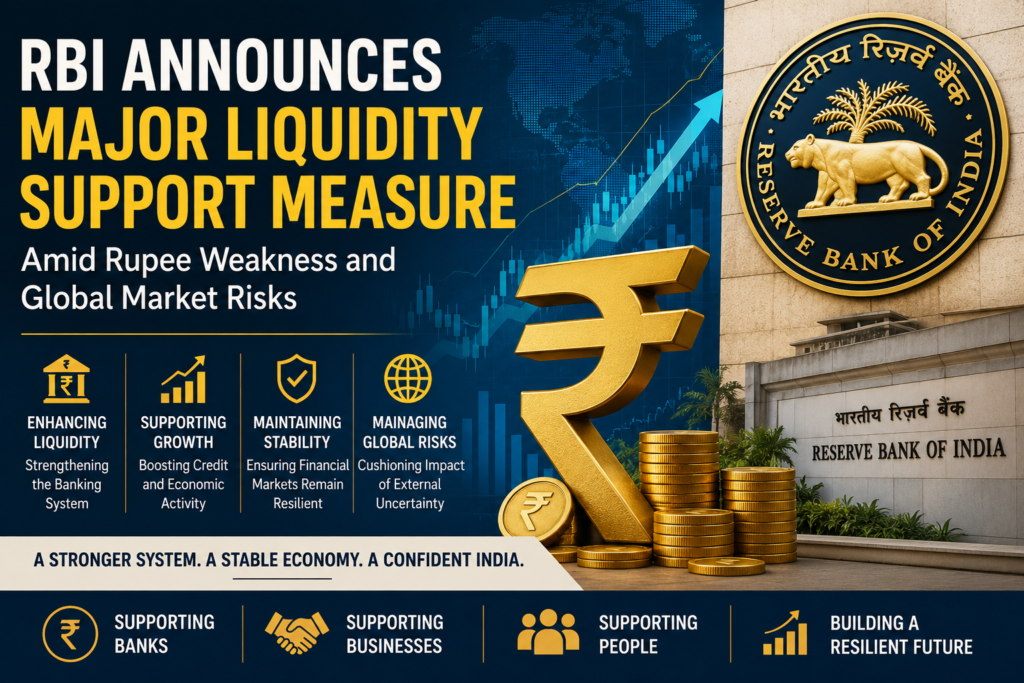
The Reserve Bank of India (RBI) has announced a major liquidity support measure aimed at stabilizing financial markets, supporting economic activity, and managing increasing pressure on the Indian rupee amid rising global market uncertainty.
The move comes at a time when global financial markets are facing heightened volatility due to geopolitical tensions, elevated oil prices, tightening monetary conditions in major economies, and concerns surrounding slowing global growth. The Indian rupee has also witnessed pressure against the U.S. dollar, prompting the central bank to take proactive measures to maintain liquidity and financial stability.
Economists and market analysts believe the RBI’s intervention is designed to ensure smooth functioning of India’s banking system while protecting investor confidence during a period of global financial stress.
Why the RBI Introduced the Liquidity Support Measure
Liquidity measures are introduced by central banks to ensure that banks and financial institutions have adequate funds available for lending, business operations, and market stability.
The RBI’s latest action aims to address several growing concerns including:
- Rupee depreciation
- Rising global market volatility
- Tightening global liquidity conditions
- Foreign capital outflows
- Banking system liquidity needs
- Economic growth support
The central bank’s move reflects increasing caution amid uncertain global financial conditions.
Rupee Weakness and Currency Pressure
The Indian rupee has been under pressure due to multiple international and domestic factors.
Major reasons include:
Strong U.S. Dollar
A stronger U.S. dollar often weakens emerging market currencies including the rupee.
Rising Crude Oil Prices
India imports a large share of its crude oil requirements. Higher oil prices increase import costs and pressure the currency.
Foreign Investor Outflows
Global investors often move capital toward safer assets during periods of uncertainty, affecting emerging markets.
Geopolitical Risks
Ongoing global conflicts and geopolitical instability have increased risk aversion in international markets.
The RBI’s liquidity measures are partly intended to reduce stress caused by these external pressures.
What Liquidity Support Means
Liquidity support measures typically involve steps by the central bank to inject money into the financial system.
This can help:
- Improve credit availability
- Reduce market stress
- Support banking operations
- Stabilize borrowing costs
- Maintain investor confidence
Central banks worldwide frequently use liquidity management tools during periods of economic uncertainty or financial instability.
Possible RBI Measures
While the exact structure of the RBI’s announcement may vary, common liquidity support mechanisms include:
Open Market Operations (OMO)
The RBI may purchase government securities to inject funds into the banking system.
Repo Operations
Banks can borrow short-term funds from the RBI to maintain liquidity.
Foreign Exchange Interventions
The RBI may use forex reserves to manage excessive currency volatility.
Cash Reserve Adjustments
Changes in reserve requirements can influence liquidity availability in the banking sector.
These tools help maintain financial system stability during volatile market conditions.
Impact on the Indian Economy
The RBI’s move is expected to provide support to multiple sectors of the economy.
Banking Sector Stability
Additional liquidity helps banks maintain lending activity and operational flexibility.
Business Confidence
Stable financial conditions encourage businesses to continue investment and expansion plans.
Market Sentiment
Central bank intervention often reassures investors during uncertain periods.
Economic Growth
Adequate liquidity supports economic activity by ensuring smooth credit flow across industries.
The RBI’s actions are therefore viewed as both preventive and stabilizing measures.
Global Market Risks Affecting India
India’s economy is increasingly integrated with global financial systems, making it sensitive to international developments.
Current global risks include:
- Rising oil prices
- Geopolitical conflicts
- Global inflation pressures
- U.S. interest rate policies
- Slowing global growth
- Supply chain disruptions
These factors influence currency markets, investment flows, and financial market stability worldwide.
Emerging economies like India often face stronger market volatility during global financial uncertainty.
Importance of RBI’s Role
The Reserve Bank of India plays a critical role in maintaining:
- Price stability
- Currency stability
- Financial system confidence
- Banking sector health
- Economic growth support
The central bank regularly balances inflation control with growth support while managing external financial pressures.
Its actions are closely watched by investors, businesses, banks, and international financial institutions.
Foreign Exchange Reserves and Market Confidence
India maintains substantial foreign exchange reserves which provide an important buffer during periods of global uncertainty.
Forex reserves help the RBI:
- Manage currency volatility
- Support import financing
- Stabilize investor sentiment
- Protect against external shocks
Strong reserve levels improve India’s ability to handle temporary market disruptions and capital outflows.
Impact on Borrowing Costs and Loans
Liquidity support measures can influence interest rates and borrowing conditions.
Improved liquidity may help:
- Stabilize lending rates
- Support corporate borrowing
- Improve credit availability
- Reduce short-term funding stress
Businesses and consumers often benefit when financial system liquidity remains stable during uncertain periods.
Oil Prices and India’s Economic Vulnerability
India remains highly dependent on imported energy, especially crude oil.
Rising oil prices can:
- Increase inflation
- Widen trade deficits
- Pressure the rupee
- Raise transportation costs
Global energy market instability therefore directly affects India’s financial and economic conditions.
The RBI’s measures may partly aim to cushion the economy from these external shocks.
Investor Reactions and Market Outlook
Financial markets generally respond positively when central banks act proactively to support liquidity and stability.
Investors often interpret such measures as signs that authorities are prepared to manage financial risks effectively.
However, market sentiment will also continue depending on:
- Global geopolitical developments
- U.S. Federal Reserve policies
- Oil price movements
- Foreign investment flows
Analysts expect markets to remain cautious but stable if liquidity conditions improve.
Comparison with Global Central Banks
Many global central banks are currently navigating similar challenges involving:
- Currency volatility
- Inflation management
- Economic slowdown concerns
- Financial market uncertainty
Central banks in emerging markets often use liquidity measures to stabilize domestic markets while responding to international financial developments.
The RBI’s actions reflect broader global monetary management trends during uncertain economic conditions.
Importance for Businesses and Consumers
Stable liquidity conditions are important for both businesses and ordinary consumers.
Strong banking liquidity supports:
- Business loans
- Home financing
- Consumer credit
- Infrastructure investment
- Working capital access
Financial stability also helps maintain confidence in economic activity and consumer spending.
Risks Still Remain
Despite the RBI’s intervention, several risks continue affecting global and domestic markets.
Geopolitical Tensions
Conflicts affecting energy markets and trade routes continue creating uncertainty.
Inflation Pressures
Rising commodity prices may keep inflation elevated.
Global Interest Rates
Higher interest rates in developed economies can impact capital flows into emerging markets.
Currency Volatility
Global financial uncertainty may continue pressuring emerging market currencies.
The RBI may therefore continue monitoring conditions closely in the coming months.
India’s Economic Resilience
Despite global challenges, India remains one of the world’s fastest-growing major economies.
Factors supporting India’s resilience include:
- Strong domestic demand
- Expanding infrastructure investment
- Digital economy growth
- Banking sector improvements
- Government capital expenditure
Central bank support measures are intended to preserve this economic momentum amid global volatility.
Future Outlook
Analysts believe the RBI may continue using flexible monetary and liquidity management tools depending on market conditions.
Future actions may focus on:
- Currency stability
- Inflation management
- Banking sector liquidity
- Economic growth support
The central bank is expected to remain cautious while balancing domestic growth priorities with global financial risks.
Conclusion
The RBI’s announcement of a major liquidity support measure highlights the central bank’s proactive approach toward managing financial stability amid rupee weakness and rising global market uncertainty.
As geopolitical tensions, oil price volatility, and global economic risks continue affecting international markets, the RBI’s intervention aims to maintain confidence in India’s banking system, support economic growth, and stabilize financial conditions.
The move underscores the importance of strong monetary management in navigating increasingly interconnected and unpredictable global financial environments.