
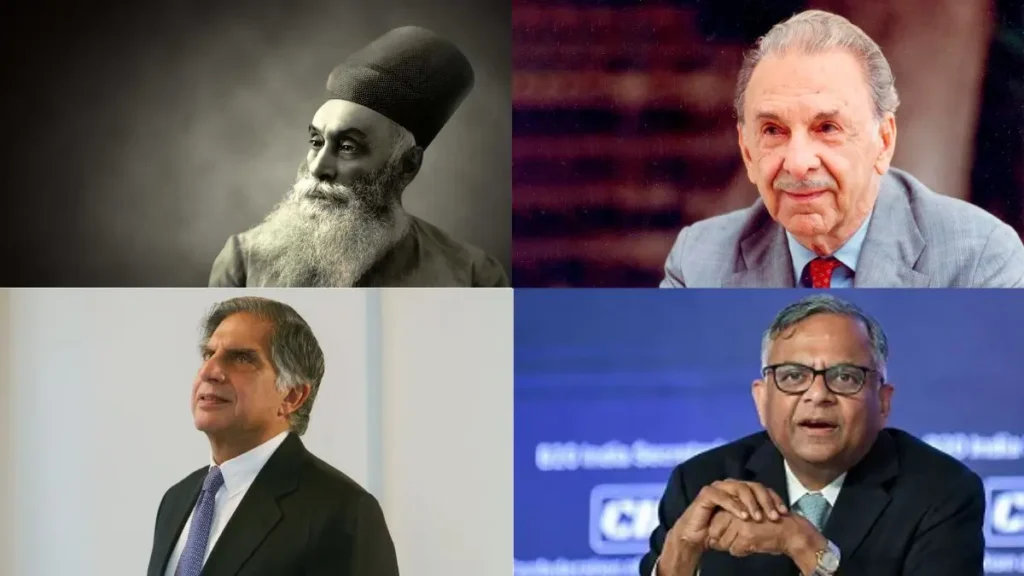
The Tata Group has been shaped by a succession of influential leaders who transformed Jamsetji Tata’s original vision into one of India’s largest and most globally recognized business groups.
From Jamsetji Tata, who founded the group in 1868, to N. Chandrasekaran, the group’s most recent chairman, each leader has left a distinct mark on the Tata legacy.
Full List of Tata Group Chairmen
| No. | Chairman | Tenure | Key Contribution |
|---|---|---|---|
| 1 | Jamsetji Nusserwanji Tata | 1868–1904 | Founded the Tata Group and established its industrial and philanthropic vision |
| 2 | Sir Dorabji Tata | 1904–1932 | Built Tata Steel and Tata Power and expanded the industrial foundation |
| 3 | Sir Nowroji Saklatvala | 1932–1938 | Strengthened the group and emphasized employee welfare |
| 4 | J.R.D. Tata | 1938–1991 | Led the group for more than five decades and drove major diversification |
| 5 | Ratan Naval Tata | 1991–2012 | Globalized the group and pursued major international acquisitions |
| 6 | Cyrus Mistry | 2012–2016 | Continued the group’s modernization and investment strategy |
| 7 | Ratan Naval Tata — Interim Chairman | 2016–2017 | Returned temporarily following Mistry’s removal |
| 8 | N. Chandrasekaran | 2017–2027* | Led the group through digital expansion, global growth and new businesses |
*Chandrasekaran’s current term runs until February 2027. In August 2026, he announced that he would not seek another term and would serve out his existing term.
1. Jamsetji Tata — The Founder
Jamsetji Nusserwanji Tata founded the Tata Group in 1868, laying the foundation for what would become one of India’s most diversified business conglomerates.
His vision extended far beyond business. He envisioned an industrial India with strong capabilities in steel, power, science, education and hospitality.
Among the dreams associated with his legacy were:
- A world-class hotel
- India’s own steel industry
- A major hydroelectric power project
- A leading scientific research institution
The Taj Mahal Palace opened in 1903, while several of his larger industrial and educational ambitions were realized by his successors.
2. Sir Dorabji Tata — Building the Industrial Foundation
After Jamsetji Tata’s death in 1904, his elder son Sir Dorabji Tata took forward his father’s ambitions.
Dorabji played a crucial role in establishing Tata Iron and Steel Company, now Tata Steel, and Tata Power.
His tenure transformed the Tata Group from a growing business house into a major industrial enterprise.
He also established the Sir Dorabji Tata Trust, strengthening the group’s tradition of philanthropy.
3. Sir Nowroji Saklatvala — Employee Welfare and Consolidation
Sir Nowroji Saklatvala became chairman in 1932, succeeding Sir Dorabji Tata.
He focused strongly on employee welfare and organizational consolidation. Tata’s official history describes him as a leader who placed considerable emphasis on the welfare of employees.
His tenure lasted until 1938.
4. J.R.D. Tata — The Longest Era of Leadership
Jehangir Ratanji Dadabhoy Tata, popularly known as J.R.D. Tata, became chairman in 1938.
He would go on to lead the Tata Group for more than five decades, making his tenure one of the most influential chapters in Indian corporate history.
JRD was instrumental in expanding the group into numerous sectors, including:
- Aviation
- Automobiles
- Chemicals
- Hotels
- Engineering
- Information technology
- Consumer businesses
He was also a pioneer of Indian civil aviation and played a major role in the development of Air India.
5. Ratan Tata — Taking the Group Global
Ratan Naval Tata became chairman in March 1991, at a transformative moment for India’s economy.
His leadership coincided with India’s economic liberalization and marked a major shift in the Tata Group’s strategy.
Under Ratan Tata, the group became significantly more global, with major international acquisitions including:
- Tetley
- Corus
- Jaguar Land Rover
He also encouraged innovation and helped make the Tata Group more cohesive across its many businesses.
Ratan Tata retired as chairman in 2012.
6. Cyrus Mistry — A Short-Lived Chairmanship
Cyrus Mistry succeeded Ratan Tata in December 2012.
Mistry had been associated with the Tata Group for several years before becoming chairman and was tasked with steering the conglomerate through its next phase of growth.
His tenure, however, lasted only about four years. In October 2016, the Tata Sons board removed him as chairman.
The decision triggered a prolonged corporate and legal dispute involving the Tata Group and Mistry.
7. Ratan Tata — Interim Return
Following Cyrus Mistry’s removal, Ratan Tata returned as interim chairman of Tata Sons in October 2016.
He remained in the position until February 2017, when N. Chandrasekaran took over.
The interim period helped the group navigate the leadership transition and identify its next permanent chairman.
8. N. Chandrasekaran — Technology and Global Expansion
Natarajan Chandrasekaran became chairman of Tata Sons in February 2017.
He was the first chairman of Tata Sons who was not born into the Tata family and had previously served as CEO and MD of Tata Consultancy Services (TCS).
His tenure was marked by expansion into several high-growth sectors and an increased focus on technology and global competitiveness.
Under Chandrasekaran, the Tata Group expanded its presence in areas including:
- Aviation
- Semiconductors
- Electronics
- Digital businesses
- Electric vehicles
- Consumer businesses
- Renewable energy
He also oversaw the group’s acquisition of Air India and its broader aviation consolidation strategy.
In August 2026, Chandrasekaran announced that he would not seek a third term as chairman of Tata Sons. He is expected to continue through his current term, which ends in February 2027.
Tata Group Leadership Timeline
1868 → Jamsetji Tata begins the Tata enterprise
1904 → Sir Dorabji Tata takes over
1932 → Sir Nowroji Saklatvala becomes chairman
1938 → J.R.D. Tata begins his long tenure
1991 → Ratan Tata becomes chairman
2012 → Cyrus Mistry takes over
2016 → Ratan Tata returns as interim chairman
2017 → N. Chandrasekaran becomes chairman
2026 → Chandrasekaran announces he will not seek another term
February 2027 → Chandrasekaran’s current term is scheduled to end
How Tata Leadership Has Evolved
The history of Tata leadership can broadly be divided into several phases:
🏭 Industrial Foundation
Jamsetji Tata and Sir Dorabji Tata established the group’s industrial base.
🤝 Consolidation and Values
Sir Nowroji Saklatvala strengthened organizational stability and employee welfare.
🌐 Diversification
J.R.D. Tata transformed Tata into a diversified business group spanning numerous industries.
🌍 Globalization
Ratan Tata accelerated international expansion and turned Tata into a globally recognized brand.
💻 Technology and Transformation
N. Chandrasekaran brought a technology-driven approach while expanding into new-age sectors.
The Tata Legacy
The Tata Group’s leadership history is unusual because its chairmen have generally been associated with a long-term philosophy rather than short-term business performance.
The group’s evolution reflects a consistent emphasis on:
- Nation-building
- Innovation
- Corporate responsibility
- Philanthropy
- Long-term value creation
- Global competitiveness
Tata’s official history notes that every chairman of Tata Sons has left a distinct imprint on the organization.
Conclusion
From Jamsetji Tata’s vision in 1868 to the technology-led transformation under N. Chandrasekaran, the Tata Group’s leadership journey spans more than 150 years.
The eight leadership phases—from Jamsetji Tata and Dorabji Tata to J.R.D. Tata, Ratan Tata, Cyrus Mistry and Chandrasekaran—reflect the changing face of Indian business.
As Chandrasekaran approaches the end of his current term in 2027, the Tata Group stands at another important leadership transition, with its next chairman expected to shape the conglomerate’s strategy for the next generation.
SEO Keywords
Tata Group Chairmen List, Tata Sons Chairmen, Jamsetji Tata to N Chandrasekaran, Tata Group Chairman History, Tata Chairmen Timeline, JRD Tata Chairman, Ratan Tata Chairman, Cyrus Mistry Chairman, N Chandrasekaran Chairman, Tata Group History, Tata Sons Leadership, Tata Group 2026.