
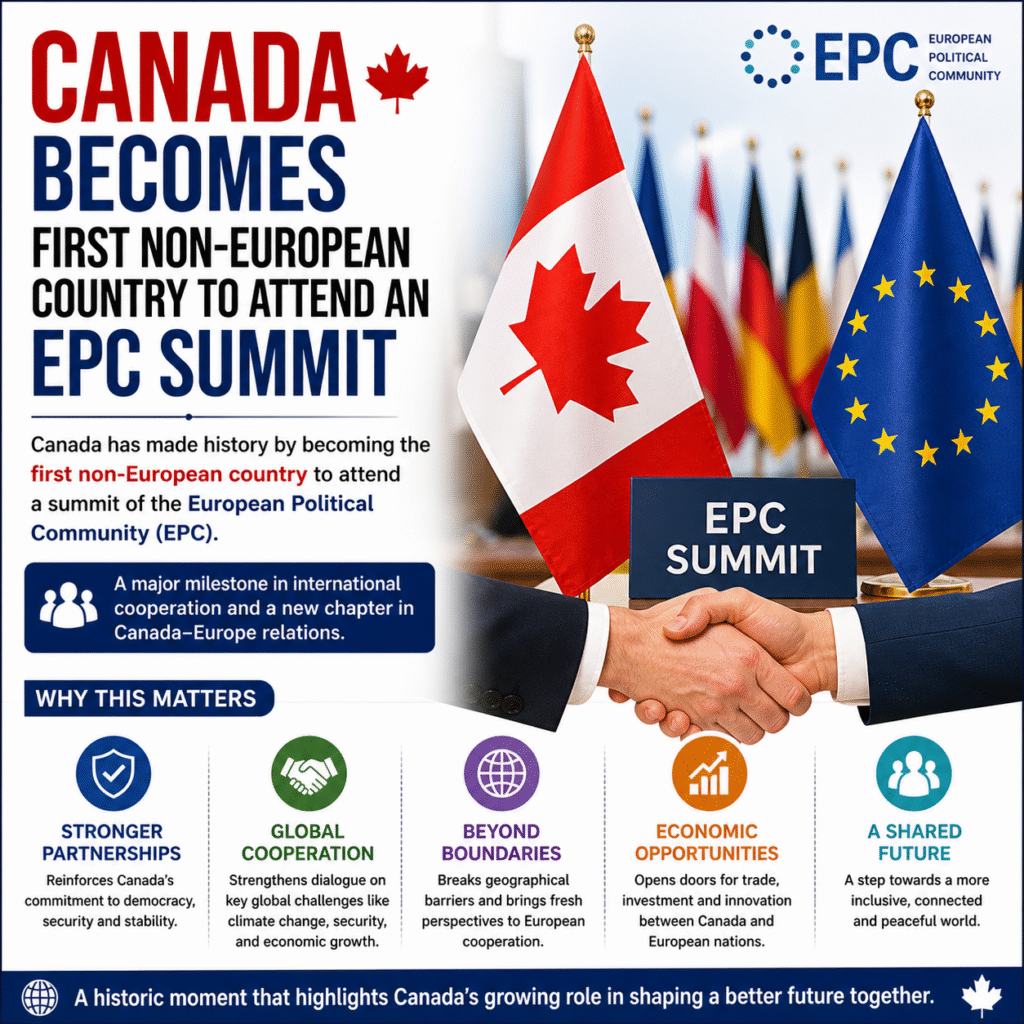
In a landmark development in global diplomacy, Canada has made history by becoming the first non-European nation to participate in a summit of the European Political Community. This move signals a significant shift in international cooperation, highlighting the growing importance of transatlantic partnerships in addressing complex global challenges.
Canada’s participation is not just symbolic—it reflects a broader transformation in how countries collaborate beyond geographical boundaries to tackle shared issues such as security, climate change, and economic stability.
🌍 Understanding the European Political Community (EPC)
The European Political Community was established in 2022 as a platform for political dialogue among European countries and their partners. Unlike formal institutions like the European Union, the EPC is designed to be flexible, allowing leaders to engage in open discussions without binding agreements.
The community focuses on key areas such as:
- Regional and global security
- Energy cooperation
- Climate action
- Economic development
- Migration and geopolitical stability
By bringing together leaders from across Europe, the EPC aims to foster unity and collaboration in addressing shared concerns.
🇨🇦 Why Canada’s Participation Is Historic
Canada’s presence at the EPC summit marks a turning point in the organization’s evolution. As the first non-European country to attend, Canada has effectively expanded the scope of the EPC beyond its regional origins.
This development is significant for several reasons:
Breaking Geographic Barriers
Canada’s inclusion demonstrates that modern diplomacy is no longer limited by geography. Shared values and interests now play a more important role in shaping alliances.
Strengthening Transatlantic Relations
Canada has long-standing ties with Europe, rooted in history, culture, and economic cooperation. Its participation reinforces these connections and opens new avenues for collaboration.
Enhancing Global Dialogue
With Canada at the table, discussions within the EPC can benefit from a broader perspective, leading to more comprehensive solutions to global challenges.
🤝 Key Areas of Collaboration
Canada’s involvement in the EPC summit is expected to enhance cooperation across multiple sectors:
🔐 Security and Defence
Canada is a key member of NATO and has strong defence partnerships with European nations. Its participation strengthens collective efforts to address security threats, including cyber risks and geopolitical tensions.
🌱 Climate Change and Sustainability
Both Canada and European countries are committed to tackling climate change. Collaboration within the EPC can accelerate progress in renewable energy, carbon reduction, and environmental protection.
💼 Trade and Economic Growth
Canada’s economic ties with Europe, particularly through agreements like CETA, provide a strong foundation for deeper trade and investment partnerships.
⚡ Energy Security
Europe’s focus on diversifying energy sources aligns with Canada’s capabilities as a major energy exporter. This creates opportunities for strategic cooperation in energy supply and sustainability.
🌐 A Shift in Global Diplomacy
Canada’s participation reflects a broader shift in international relations. Traditional alliances based on geography are being replaced by value-driven partnerships, where countries collaborate based on shared goals and principles.
This shift is driven by:
- Increasing global interdependence
- The need for coordinated responses to crises
- Shared concerns over security and stability
The EPC’s openness to non-European participants could signal the emergence of a more inclusive global diplomatic framework.
🇪🇺 Europe’s Expanding Engagement
By inviting Canada, European leaders are demonstrating a willingness to expand their diplomatic reach. This move highlights:
- Recognition of global interconnectedness
- The importance of strong partnerships with like-minded nations
- A proactive approach to addressing global challenges
It also enhances the EPC’s relevance as a platform for meaningful international dialogue.
📈 Implications for Global Politics
Canada’s inclusion in the EPC summit could have far-reaching implications:
1. Broader Participation
Other non-European countries may be invited in the future, transforming the EPC into a more global forum.
2. Stronger Alliances
The move strengthens cooperation among democratic nations, particularly in times of geopolitical uncertainty.
3. Coordinated Policy-Making
Joint discussions can lead to more aligned policies on trade, security, and environmental issues.
4. Increased Influence
Canada’s participation enhances its role in global diplomacy, positioning it as a key player in international decision-making.
⚠️ Challenges and Considerations
While the development is promising, it also raises important questions:
- Will the EPC maintain its European identity?
- How will it balance inclusivity with effectiveness?
- Could expanded participation dilute its original purpose?
Addressing these challenges will be crucial for the EPC’s future success.
🔮 The Road Ahead
Canada’s participation is likely just the beginning of a broader transformation. The EPC may evolve into a more inclusive platform, inviting partners from other regions who share similar values.
Future developments could include:
- Expanded membership or participation
- Greater focus on global issues
- Enhanced collaboration between regions
This evolution could redefine how international diplomacy is conducted in the 21st century.
✨ Conclusion
Canada becoming the first non-European country to attend a summit of the European Political Community marks a historic milestone in global diplomacy. It reflects the growing importance of collaboration beyond regional boundaries and highlights the need for collective action in addressing global challenges.
As the EPC continues to evolve, Canada’s participation could pave the way for a more inclusive, dynamic, and effective approach to international cooperation. This moment not only strengthens transatlantic ties but also signals a future where global partnerships are defined by shared values and common goals rather than geography alone.