
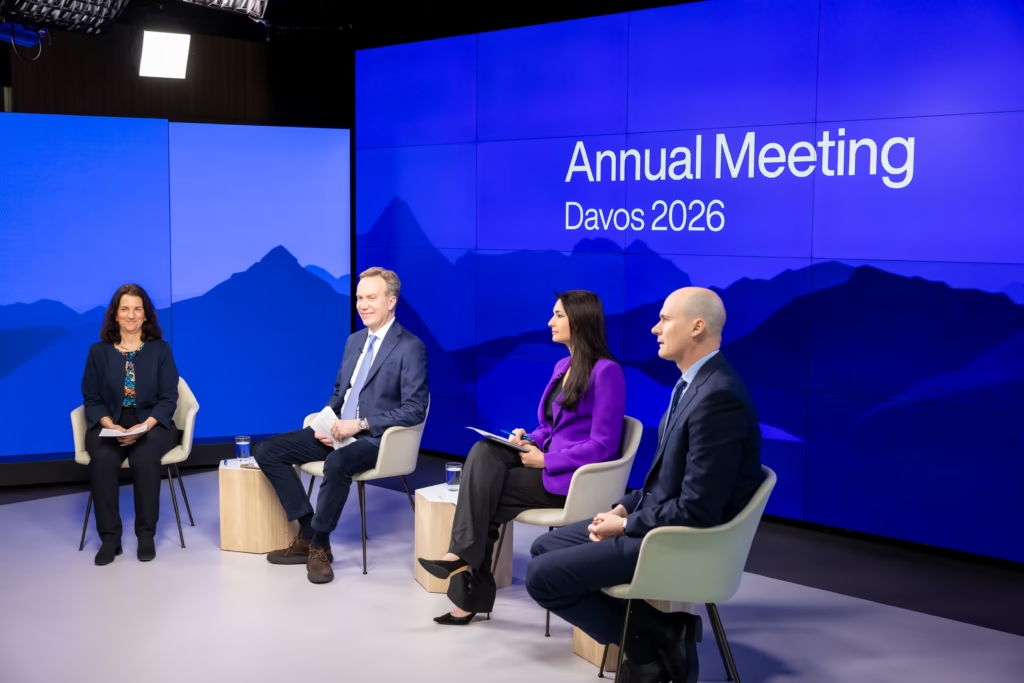
The 56th Annual Meeting of the World Economic Forum (WEF)—widely known as Davos 2026—is one of the most anticipated global diplomatic and economic gatherings of the year. Held in Davos-Klosters, Switzerland, this summit brings together heads of state, senior government officials, top business leaders, civil society figures, and innovators to discuss and shape responses to the world’s most pressing challenges.
Scheduled from 19–23 January 2026, this edition of Davos focuses on strengthening global cooperation amid growing economic, technological, and geopolitical complexity. More than just a meeting, it is a space where ideas, policies, and partnerships are forged that influence global governance, trade, climate action, digital transformation, and human development.
What Is the World Economic Forum and the Annual Meeting at Davos?
The World Economic Forum (WEF) is an international organization for public-private cooperation. Its Annual Meeting in Davos—held every January in the Alpine town of Davos-Klosters, Switzerland—is its flagship event. It brings together global decision-makers from:
- Governments and multilateral institutions
- Global corporations and financial institutions
- Academia and think tanks
- Non-governmental organizations and cultural leaders
The Forum’s goal is to promote partnerships and dialogue that can lead to practical global solutions. While critics sometimes describe it as elitist, its official mission remains fostering public-private collaboration to improve the state of the world.
Key Dates and Format of Davos 2026
- 📆 19–23 January 2026: Main session dates for Davos 2026.
- 📍 Davos-Klosters, Switzerland and virtual streaming for wider public access.
The Annual Meeting combines formal sessions, private roundtables, panels, and bilateral meetings across a vast agenda. Over 200 sessions will be livestreamed, enabling broader participation beyond the summit.
Participants can expect:
- Leaders from government, business, civil society
- Tech pioneers and scientific innovators
- Thought leaders from international organisations
- Media and cultural influencers
A record-high number of participants—close to 3,000 delegates from over 130 countries—are expected, including 400 top political leaders and nearly 850 CEOs of leading global companies.
The Theme: “A Spirit of Dialogue”
The official theme for Davos 2026 is “A Spirit of Dialogue.” This theme reflects the urgent need for open communication and collaboration at a time of heightened global fragmentation.
Under this banner, the Forum seeks to:
- Build mutual understanding amid geopolitical tension
- Encourage cooperation in economic, technological, and environmental domains
- Foster constructive partnerships between public and private sectors
- Create shared pathways to sustainable, inclusive growth
This focus recognizes that many of today’s challenges—including economic instability, technological disruption, climate change, and conflict—cannot be resolved by individual nations in isolation but require multilateral solutions rooted in sustained dialogue.
Participants and Key Attendees
Davos 2026 gathers an unprecedented breadth of global actors:
Heads of State and Government
Several high-profile leaders are confirmed or expected, including:
- U.S. President Donald Trump, leading a large delegation marking the largest U.S. presence in recent years.
- Presidents and prime ministers from Europe, Asia, Africa, and Latin America
- Ukraine’s President Volodymyr Zelenskyy engaging on war-related and post-conflict recovery issues.
Business Leaders and CEOs
Nearly 850 of the world’s top corporate executives and industry pioneers will attend, representing sectors such as:
- Technology and AI
- Banking and finance
- Energy and sustainability
- Healthcare and biotech
Global corporate leaders, including tech industry executives, will shape discussions on innovation, digital transformation, and economic growth.
Civil Society, Academia and Thought Leaders
NGOs, global academic institutions, and industry associations contribute to discussions on climate change, inequality, education, and ethical technology deployment.
Regional Delegations With Strategic Focus
Several national and subnational governments are using the Davos platform strategically:
- India’s delegation is actively promoting investment and technology partnerships under the “Partner with Bharat” campaign.
- States like Assam and Gujarat are showcasing investment opportunities and sector-specific goals at dedicated pavilions and sessions.
Major Global Challenges in Focus at Davos 2026
Davos 2026 is organised around a set of five defining global challenges, which are intended to structure dialogue, action plans, and partnerships:
1. Cooperation in a Contested World
Geopolitical tensions—such as competition between major powers and ongoing conflicts—are front and centre. Leaders will explore diplomatic and economic strategies to reduce instability and foster cooperation.
2. Unlocking New Sources of Growth
Discussion will revolve around sustainable economic expansion, trade, infrastructure investment, and equitable development models that ensure prosperity benefits broad populations.
3. Investing in People
Human capital development, skills for the future workforce, education access, and health systems will remain key priorities as countries navigate demographic shifts and skill deficits.
4. Deploying Innovation Responsibly
Artificial intelligence, biotechnology, next-generation computing and renewable energy technologies are reshaping societies. Sessions will explore how to scale these innovations while managing ethical, social and regulatory implications.
5. Building Prosperity Within Planetary Boundaries
Climate change, biodiversity loss, sustainable agriculture, and resilient ecosystems are core components of the agenda—echoing global climate commitments and sustainable development goals.
Key Sessions and Highlights to Watch
While the full agenda includes hundreds of talks and panels, several areas are receiving particular attention:
AI and Technology Governance
AI leadership, agentic AI, and ethical tech deployment will be explored across multiple sessions, reflecting both economic potential and risk governance concerns.
Geoeconomic Tensions and Trade Policy
Debates around tariffs, supply chains, and economic power balances will be high on the agenda, particularly given recent global tariff announcements and trade disputes.
Post-Conflict Reconstruction
Ukraine’s recovery roadmap and peacebuilding mechanisms will be discussed by international political and financial stakeholders, underscoring the role of economic stability in peace efforts.
Climate and Energy Transition
Sustainable energy, decarbonisation strategies, and nature-based solutions will be debated as part of broader climate resilience talks.
Private-Public Partnerships
Given the Forum’s multistakeholder ethos, collaboration frameworks mixing government policy with private innovation investment will feature prominently.
Security and Public Attention
Given the high level of participation and global interest, the host town of Davos has boosted security measures significantly, including advanced surveillance technology and deployment of thousands of personnel to ensure safety for delegates and delegates’ meetings.
Criticism and Public Engagement
Davos is often under scrutiny for perceived elitism and debate over whether it truly addresses grassroots concerns. While some commentators argue the Forum favours powerful interests, organisers emphasise inclusive dialogue and action. Public access panels and livestreamed sessions are part of efforts to broaden engagement beyond delegates.
Conclusion: Davos 2026 as a Pivotal Global Forum
Davos 2026, under the theme “A Spirit of Dialogue,” represents a pivotal opportunity for the world’s leaders to step beyond divisions and tackle shared challenges—from geopolitics and global economics to technology governance and climate resilience. With record participation, ambitious agendas, and diverse voices, the 56th Annual Meeting of the World Economic Forum aims to shape the global narrative in a year marked by uncertainty and transformation.
As policymakers, corporate leaders, and civil society representatives converge, Davos 2026 will remain a defining platform for dialogue that has the potential to catalyse real progress in addressing humanity’s most pressing priorities.
SEO Keywords Integrated: Davos 2026, World Economic Forum Annual Meeting, Davos dates, WEF theme, global challenges, geopolitics, AI governance, sustainable development, economic cooperation, climate resilience, international dialogue, global leadership 2026.