
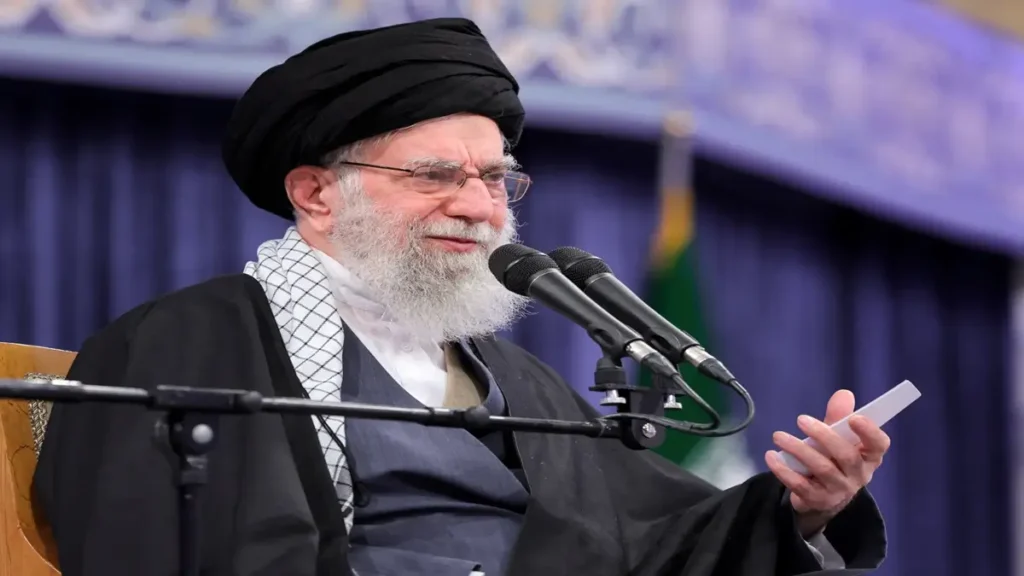
In a development that has sent shockwaves across global political corridors, Iran’s Supreme Leader Ayatollah Ali Khamenei has been officially confirmed dead following major coordinated military strikes carried out by the United States and Israel. Iranian state media announced his death after sustained air and missile operations targeted high-level strategic locations in Tehran.
This event marks one of the most dramatic geopolitical turning points in recent Middle Eastern history, raising urgent questions about regional stability, leadership succession in Iran, and the future of U.S.–Iran–Israel relations.
A Leader Who Shaped Modern Iran
Ayatollah Ali Khamenei served as Iran’s Supreme Leader since 1989, succeeding Ayatollah Ruhollah Khomeini. For over three decades, he was the highest political and religious authority in the Islamic Republic of Iran.
During his tenure, Iran witnessed:
- Intensified tensions with the United States and Israel
- Expansion of regional influence through allied groups across the Middle East
- Continued advancement of its nuclear program despite global sanctions
- Strict domestic policies and suppression of protests
- Strong anti-Western foreign policy positions
Khamenei played a decisive role in shaping Iran’s political identity, security strategy, and ideological direction for more than 35 years.
The Military Operation That Changed the Region
According to official confirmations, the U.S. and Israel conducted coordinated strikes aimed at strategic Iranian military and nuclear infrastructure. The operation reportedly focused on command centers, missile facilities, and high-level leadership compounds.
Shortly after the strikes, intelligence assessments indicated severe damage to the Supreme Leader’s compound. Iranian authorities later confirmed that Khamenei succumbed to injuries sustained during the attack.
The scale and precision of the operation have made it one of the most significant direct confrontations between Iran and its long-standing adversaries.
Immediate Reactions Inside Iran
The confirmation of Khamenei’s death triggered widespread reactions across Iran.
Official Response
Iranian authorities declared a national mourning period, referring to his death as martyrdom. State television broadcast tributes highlighting his leadership and resistance against foreign powers.
The Islamic Revolutionary Guard Corps (IRGC) vowed retaliation, warning that responses would be swift and severe. Military readiness levels were elevated across the country.
Public Sentiment
Public reaction has been mixed:
- In some areas, supporters gathered in mourning demonstrations.
- In other parts of the country, particularly among critics of the regime, there were reports of subdued celebrations and calls for political reform.
The internal atmosphere remains tense, with heightened security presence in major cities.
Escalation Across the Middle East
The immediate aftermath saw increased military alerts across the region.
- Israel activated missile defense systems amid threats of retaliation.
- U.S. military bases in the Gulf region were placed on high alert.
- Neighboring countries strengthened border security and airspace monitoring.
Several nations have urged restraint to prevent a broader regional conflict. Global leaders are closely monitoring the evolving situation, fearing escalation into a wider confrontation.
Leadership Vacuum in Iran
The death of the Supreme Leader creates a significant constitutional and political challenge for Iran.
As the country’s highest authority, Khamenei had control over:
- Foreign policy decisions
- Military command structures
- Judicial oversight
- Strategic national security directives
According to Iran’s constitution, the Assembly of Experts is responsible for appointing a new Supreme Leader. However, the transition process could face internal disagreements and factional struggles.
Some analysts believe that a temporary leadership arrangement may be introduced until a permanent successor is chosen. The coming weeks will be critical in determining whether Iran experiences a smooth transition or political instability.
Impact on Global Oil Markets and Economy
The geopolitical shock has already influenced global financial markets.
Oil prices have surged due to fears of supply disruptions from the Middle East. Investors are reacting cautiously amid uncertainty about further military escalation.
Energy-importing countries are particularly concerned about potential disruptions in the Strait of Hormuz, a key global oil transit route.
Economic analysts warn that prolonged instability could affect global trade, currency markets, and investor confidence.
U.S.–Iran Relations at a Crossroads
For decades, U.S.–Iran relations have been marked by sanctions, diplomatic breakdowns, and proxy conflicts. The direct elimination of Iran’s Supreme Leader represents an unprecedented escalation.
Key questions now include:
- Will Iran pursue aggressive retaliation?
- Could diplomatic channels reopen under new leadership?
- Will international mediators step in to prevent prolonged conflict?
The direction of Iran’s next leadership will significantly shape future diplomatic and military dynamics.
Israel’s Strategic Position
Israel has long viewed Iran’s nuclear ambitions and regional influence as existential threats. The removal of Khamenei may be perceived domestically in Israel as a strategic victory.
However, security risks remain high. Iran’s regional allies and proxy networks could escalate tensions through indirect responses.
Israeli defense systems remain on high alert amid continued uncertainty.
A Divisive Legacy
Ayatollah Ali Khamenei’s legacy will remain deeply polarizing.
Supporters credit him with preserving Iran’s sovereignty and resisting Western influence. They highlight his commitment to maintaining ideological consistency and regional power.
Critics argue that his policies contributed to economic strain, international isolation, and suppression of dissent within Iran.
Regardless of perspective, his leadership defined an era in Iran’s modern history.
What Comes Next?
The coming days and weeks will determine whether this event leads to prolonged conflict or a strategic reset in Middle Eastern geopolitics.
Critical developments to watch include:
- Appointment of a new Supreme Leader
- Military responses or de-escalation signals
- International diplomatic interventions
- Regional proxy reactions
The global community is urging calm, emphasizing dialogue over escalation.
Conclusion
The confirmed death of Iran’s Supreme Leader Ayatollah Ali Khamenei following major U.S.–Israel strikes marks one of the most consequential geopolitical events of the decade.
It represents a turning point not only for Iran but for the broader Middle East and global security landscape. Leadership transition, regional stability, and international diplomacy now stand at a delicate crossroads.
As the situation unfolds, the world watches closely. The decisions made in the aftermath will shape the political and security architecture of the region for years to come.