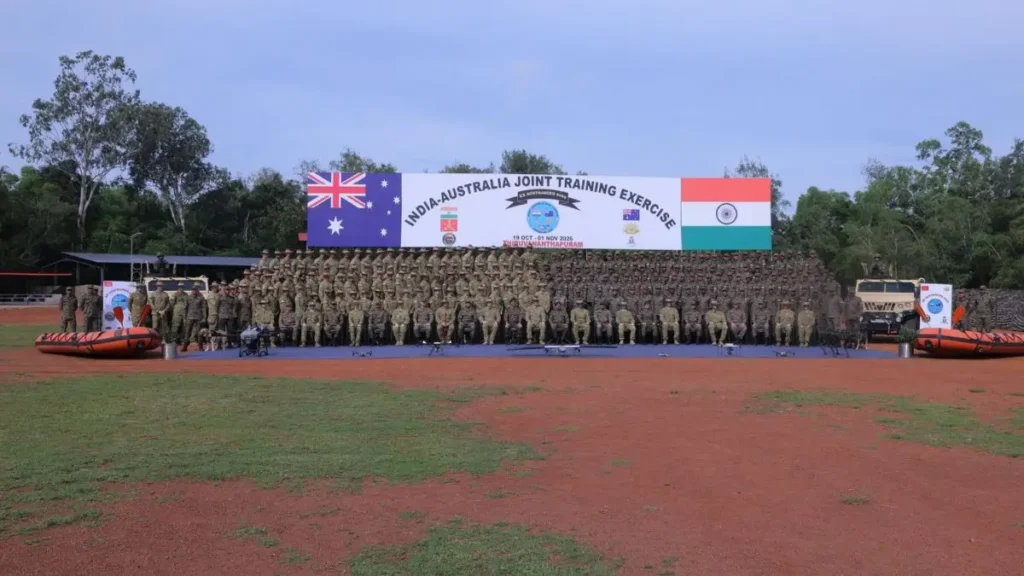
India-Australia Joint Military Exercise AUSTRAHIND 2026 Begins in Kerala
India and Australia continue to strengthen their defence partnership through joint military training, with Exercise AUSTRAHIND serving as an important platform for enhancing cooperation between the two armies. The exercise focuses on improving interoperability, sharing operational experience and developing coordinated responses to common security challenges.
The headline indicates that the 2026 edition has begun in Kerala. The precise commencement date, venue, participating units and official objectives should be confirmed against the latest Ministry of Defence announcement before publication.
1. AUSTRAHIND 2026: Key highlights
Commencement date
19 October 2026
Venue
Foreign Training Node, Thiruvananthapuram, Kerala
Participants
Approximately 120 personnel from each country
Edition
Fifth edition
Scheduled conclusion
1 November 2026
Press Information Bureau
+1
2. Which countries are participating?
The exercise involves the armed forces of two countries:
India: The Indian Army contingent includes troops from the Garhwal Rifles, along with personnel from other arms and services.
Australia: The Australian Army contingent includes troops from the 13th Brigade.
New Zealand: An observer delegation is participating for the first time.
The inclusion of New Zealand observers adds a new element to this year’s exercise, providing an opportunity to observe the joint training and exchange professional insights.
Press Information Bureau
+1
3. What is the theme of AUSTRAHIND 2026?
The official theme is:
“Joint Sub-Conventional Operations in Island and Coastal Environment under Chapter VII of the UN Mandate.”
Press Information Bureau
The training focuses on coordinated military operations in coastal and island environments. Activities include joint planning, tactical drills, surveillance and reconnaissance, protection of vital installations, and responses to humanitarian assistance and disaster relief (HADR) contingencies.
Training under realistic operational conditions is intended to strengthen interoperability, jointmanship and operational coordination between the two armies.
Press Information Bureau
+1
4. Why is this military exercise important?
AUSTRAHIND provides a platform for India and Australia to:
Improve coordination between their respective armies.
Develop a shared understanding of operational tactics and procedures.
Exchange military expertise and best practices.
Practise responses to challenges in island and coastal terrain.
Strengthen defence cooperation and mutual trust.
The exercise forms part of broader defence engagement between India and Australia and supports their stated interest in peace, stability and security in the Indo-Pacific region.
Press Information Bureau
5. Background: Previous edition
The fourth edition of AUSTRAHIND was held at Irwin Barracks in Perth, Australia, from 13 to 26 October 2025. The 2026 edition brings the exercise back to India, with training taking place in Thiruvananthapuram, Kerala.
Press Information Bureau
6. Important facts for competitive examinations
Question
Answer
AUSTRAHIND is conducted between which countries?
India and Australia
Which edition is being held in 2026?
Fifth
Where is the 2026 exercise taking place?
Thiruvananthapuram, Kerala
When did it commence?
19 October 2026
When is it scheduled to conclude?
1 November 2026
Which Indian Army regiment is represented?
Garhwal Rifles
Which Australian Army formation is participating?
13th Brigade
Which country is participating as an observer for the first time?
New Zealand
What type of terrain is the exercise focused on?
Island and coastal environments
Source: Ministry of Defence, Government of India.
Press Information Bureau
Conclusion
AUSTRAHIND 2026 marks another step in India–Australia military cooperation. Conducted in Thiruvananthapuram from 19 October to 1 November, the fifth edition focuses on joint operations in island and coastal environments, tactical coordination and the exchange of military expertise.
The participation of approximately 240 personnel from the two armies, alongside a first-time observer delegation from New Zealand, makes this edition a significant development in their ongoing defence engagement.