
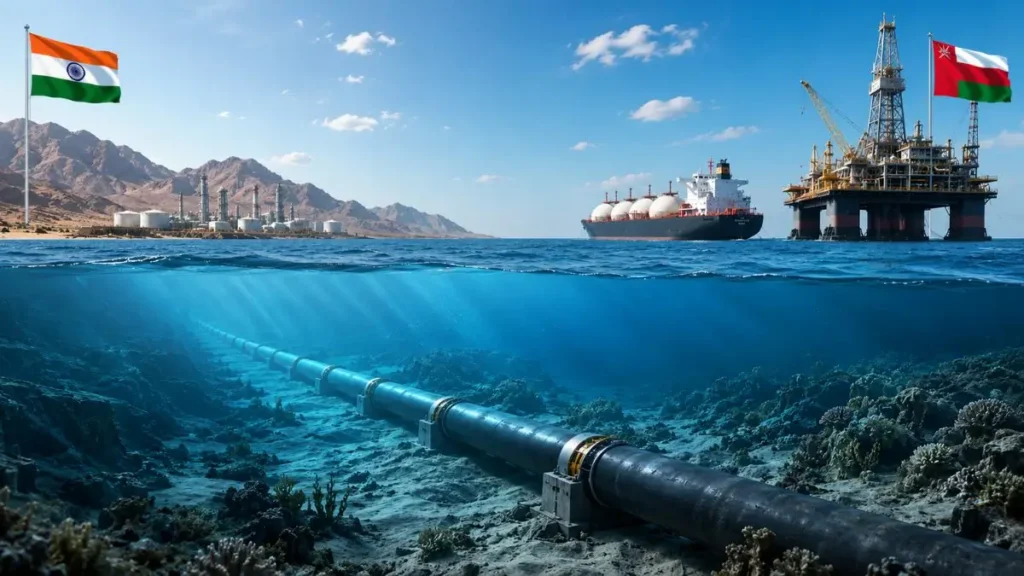
India is preparing for one of its most ambitious energy infrastructure projects as the government revives plans for a massive subsea gas pipeline connecting Oman directly to Gujarat. Estimated to cost nearly ₹40,000 crore, the proposed deep-sea pipeline aims to strengthen India’s energy security, reduce dependency on vulnerable global shipping routes, and ensure uninterrupted natural gas supply from the Gulf region.
The project has gained urgency following rising geopolitical tensions around the Strait of Hormuz, one of the world’s most critical oil and gas transit chokepoints. With India heavily dependent on imported energy, policymakers are now focusing on long-term strategies to secure stable and affordable gas supplies.
What Is the Oman-Gujarat Subsea Gas Pipeline Project?
The proposed project involves laying a deep-water natural gas pipeline under the Arabian Sea from Oman to the Gujarat coast in western India. The pipeline is expected to stretch approximately 1,200 to 2,000 kilometers depending on the final route selected.
Reports suggest the pipeline could be constructed at depths of nearly 3,450 meters below sea level, making it one of the deepest undersea gas pipelines in the world.
The project is being viewed as a strategic energy corridor that can bypass geopolitical risks associated with traditional maritime routes and politically unstable land-based pipeline networks.
Why India Is Reviving the Project in 2026
The idea of a deep-sea gas pipeline between Oman and India is not new. Discussions around the project began decades ago, but technological limitations, high costs, and geopolitical concerns delayed progress.
However, the situation has changed dramatically in recent years.
Growing tensions in the Middle East, especially around the Strait of Hormuz, have highlighted the risks associated with India’s heavy dependence on imported oil and liquefied natural gas transported through vulnerable sea lanes.
India imports a major share of its crude oil and LNG requirements from Gulf countries. Any disruption in shipping routes can lead to higher fuel prices, supply shortages, and economic instability.
The subsea pipeline is now being viewed as a long-term solution for uninterrupted and stable gas supply.
Strategic Importance of the Strait of Hormuz
The Strait of Hormuz is one of the world’s most important energy trade routes. A significant portion of global oil and natural gas exports passes through this narrow waterway connecting the Persian Gulf to the Arabian Sea.
For India, the region is critically important because much of its imported crude oil and LPG travels through Hormuz. Recent geopolitical conflicts and fears of shipping disruptions have raised concerns about India’s energy vulnerability.
The Oman-Gujarat pipeline would help India partially bypass these risks by creating a direct and secure gas transportation route under the sea.
Project Cost and Timeline
According to multiple reports, the estimated investment for the project ranges between ₹40,000 crore and ₹43,000 crore.
If approved, construction could take approximately five to seven years to complete. Government agencies including GAIL, Indian Oil Corporation, and Engineers India Limited are expected to conduct detailed feasibility studies and technical assessments for the project.
The government is also expected to hold discussions with Oman regarding financing, supply agreements, and project execution strategies.
Technical Challenges of the Pipeline
Building a pipeline at depths exceeding 3,000 meters is an enormous engineering challenge. Underwater pressure at such depths is extremely high, requiring advanced materials, deep-sea technology, and sophisticated monitoring systems.
The proposed route may pass through tectonically sensitive areas such as the Owen Fracture Zone in the Arabian Sea, making the project even more complex.
However, advancements in deep-sea pipeline construction and repair technology have improved the feasibility of such projects. Reports indicate that preliminary seabed studies and test pipeline installations have already been conducted to analyze underwater conditions.
Economic Benefits for India
The Oman-Gujarat pipeline could significantly improve India’s energy economics.
Currently, India imports LNG through tankers, which requires expensive liquefaction, transportation, and regasification processes. Direct pipeline gas is expected to be more affordable and stable in pricing.
Experts believe the project could:
- Reduce natural gas import costs
- Improve long-term energy security
- Lower dependence on LNG shipping
- Support industrial growth
- Strengthen India’s gas-based economy
- Encourage cleaner fuel adoption
India aims to increase the share of natural gas in its energy mix over the coming years as part of its transition toward cleaner and more sustainable energy sources.
Geopolitical Advantages
One of the biggest advantages of the project is its geopolitical significance.
Unlike land-based pipeline projects such as the TAPI pipeline, which passes through politically unstable regions including Afghanistan and Pakistan, the Oman-Gujarat subsea route avoids sensitive border conflicts entirely.
This gives India greater control over energy transportation and reduces dependency on transit nations.
The pipeline could also strengthen India’s strategic ties with Gulf countries, especially Oman and the UAE, while expanding regional energy cooperation.
Potential Supply Sources
The subsea pipeline could potentially provide India access to natural gas reserves from several Gulf and Central Asian countries, including:
- Oman
- United Arab Emirates
- Qatar
- Saudi Arabia
- Iran
- Turkmenistan
These regions collectively hold some of the world’s largest natural gas reserves.
This would diversify India’s energy sources and improve supply reliability.
Environmental and Energy Transition Impact
Natural gas is considered a cleaner fossil fuel compared to coal and oil. India’s growing focus on reducing carbon emissions and improving air quality has increased the importance of gas-based energy systems.
The pipeline could support:
- Cleaner industrial fuel usage
- Gas-powered transportation
- Urban gas distribution
- Reduced coal dependency
- Lower carbon emissions
As India expands its renewable energy infrastructure, natural gas is expected to act as a transition fuel supporting the country’s energy needs.
Challenges Ahead
Despite its strategic importance, the project still faces several hurdles.
These include:
- High construction costs
- Deep-sea engineering risks
- Financing requirements
- Environmental clearances
- Long approval timelines
- Geopolitical negotiations
Global energy market volatility and future renewable energy adoption trends may also influence the project’s commercial viability.
However, experts believe the long-term strategic benefits could outweigh these challenges.
Conclusion
India’s proposed ₹40,000 crore subsea gas pipeline from Oman to Gujarat represents a major step toward strengthening the country’s energy security and reducing vulnerability to geopolitical disruptions.
The project reflects India’s growing focus on strategic infrastructure, cleaner energy, and long-term economic stability. If successfully implemented, the deep-sea pipeline could become one of the world’s most important energy corridors and transform how India secures natural gas imports for the future.