
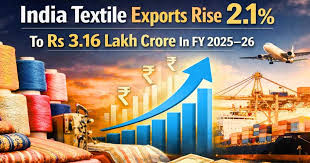
India’s textile sector has demonstrated resilience in a challenging global environment, with exports growing by 2.1% to reach ₹3.16 lakh crore in 2025–26. According to data from the Ministry of Textiles, this growth reflects steady demand recovery, improved supply chain efficiency, and sustained government support for one of the country’s most employment-intensive industries.
The modest yet significant increase highlights India’s ability to maintain momentum despite global economic uncertainties, fluctuating demand, and rising competition from other textile-exporting nations.
Overview of India’s Textile Export Performance
India’s textile and apparel industry is one of the largest contributors to the country’s export economy. It includes a wide range of products such as cotton textiles, garments, man-made fibers, home textiles, and technical textiles.
In 2025–26, the sector achieved exports worth ₹3.16 lakh crore, marking a 2.1% increase compared to the previous financial year. While the growth rate may appear moderate, it is noteworthy given the global slowdown and supply chain disruptions affecting international trade.
Key Drivers Behind the Growth
Several factors have contributed to the growth in textile exports during the 2025–26 period.
1. Recovery in Global Demand
After periods of economic uncertainty, demand for textiles in key markets such as the United States and Europe has shown gradual recovery. Retail activity has picked up, leading to increased orders for Indian manufacturers.
2. Diversification of Export Markets
Indian exporters have expanded their reach beyond traditional markets. Emerging markets in Asia, Africa, and Latin America have provided new opportunities, reducing dependence on a few regions.
3. Government Support and Policies
Government initiatives have played a crucial role in supporting the textile industry. Schemes related to production-linked incentives (PLI), export promotion, and infrastructure development have strengthened the sector’s competitiveness.
4. Focus on Value-Added Products
There has been a shift towards high-value products such as technical textiles, branded garments, and sustainable fabrics. This has helped increase export value even when volume growth remains moderate.
Segment-Wise Performance
The textile export sector comprises multiple segments, each contributing differently to overall growth.
Cotton Textiles
India remains one of the largest producers and exporters of cotton textiles. Strong global demand for natural fibers has supported this segment.
Apparel and Garments
Ready-made garments continue to be a major export category. Increased demand for fast fashion and affordable clothing has driven growth in this segment.
Man-Made Fibers (MMF)
The MMF segment is gaining traction as global preferences shift towards synthetic and blended fabrics. Investments in this area are expected to yield long-term benefits.
Technical Textiles
Technical textiles, used in industries such as healthcare, construction, and automotive, are emerging as a high-growth segment. This area offers significant potential for future expansion.
Challenges Faced by the Industry
Despite the positive growth, the textile sector faces several challenges.
Global Competition
Countries like China, Bangladesh, and Vietnam continue to dominate global textile exports. Competitive pricing and large-scale production capabilities pose challenges for Indian exporters.
Rising Input Costs
Fluctuations in raw material prices, particularly cotton and synthetic fibers, have impacted profit margins.
Supply Chain Disruptions
Global logistics issues and shipping delays have affected timely delivery, impacting export performance.
Compliance and Sustainability Requirements
International buyers are increasingly demanding sustainable and ethically produced textiles. Meeting these standards requires additional investment and adaptation.
Role of Sustainability in Textile Exports
Sustainability has become a key focus area for the global textile industry. Indian exporters are increasingly adopting eco-friendly practices such as:
- Using organic and recycled materials
- Reducing water and energy consumption
- Implementing ethical labor practices
These efforts not only meet international standards but also enhance brand value and competitiveness.
Impact on Employment and Economy
The textile industry is one of the largest employers in India, providing jobs to millions of people, particularly in rural and semi-urban areas.
The growth in exports has:
- Supported employment generation
- Boosted income levels in textile hubs
- Contributed to overall economic growth
Regions known for textile production, such as Tamil Nadu, Gujarat, and Maharashtra, continue to benefit significantly.
Government Initiatives and Future Plans
The Indian government continues to focus on strengthening the textile sector through various initiatives.
Key Focus Areas:
- Expansion of textile parks and infrastructure
- Promotion of “Make in India” for global markets
- Encouraging innovation and technology adoption
- Supporting MSMEs in the textile value chain
These initiatives aim to position India as a global leader in textile manufacturing and exports.
Future Outlook
The outlook for India’s textile exports remains positive, with several growth opportunities on the horizon.
Expected Trends:
- Increased demand for sustainable textiles
- Growth in technical textile applications
- Expansion into new international markets
- Greater adoption of automation and digital technologies
Industry experts believe that with the right strategies, India can achieve higher growth rates in the coming years.
Strategic Importance of the Textile Sector
The textile industry plays a crucial role in India’s economic landscape. It contributes significantly to:
- Export earnings
- Employment generation
- Industrial development
- Rural economy
Strengthening this sector is essential for achieving broader economic goals.
Conclusion
The 2.1% growth in India’s textile exports to ₹3.16 lakh crore in 2025–26 reflects the sector’s resilience and adaptability in a challenging global environment. While the growth may be modest, it underscores the steady progress and strong fundamentals of the industry.
With continued government support, increased focus on sustainability, and strategic expansion into new markets, India’s textile sector is well-positioned for long-term growth.
As global demand evolves, the ability of Indian exporters to innovate, adapt, and compete will determine the future trajectory of this vital industry.