
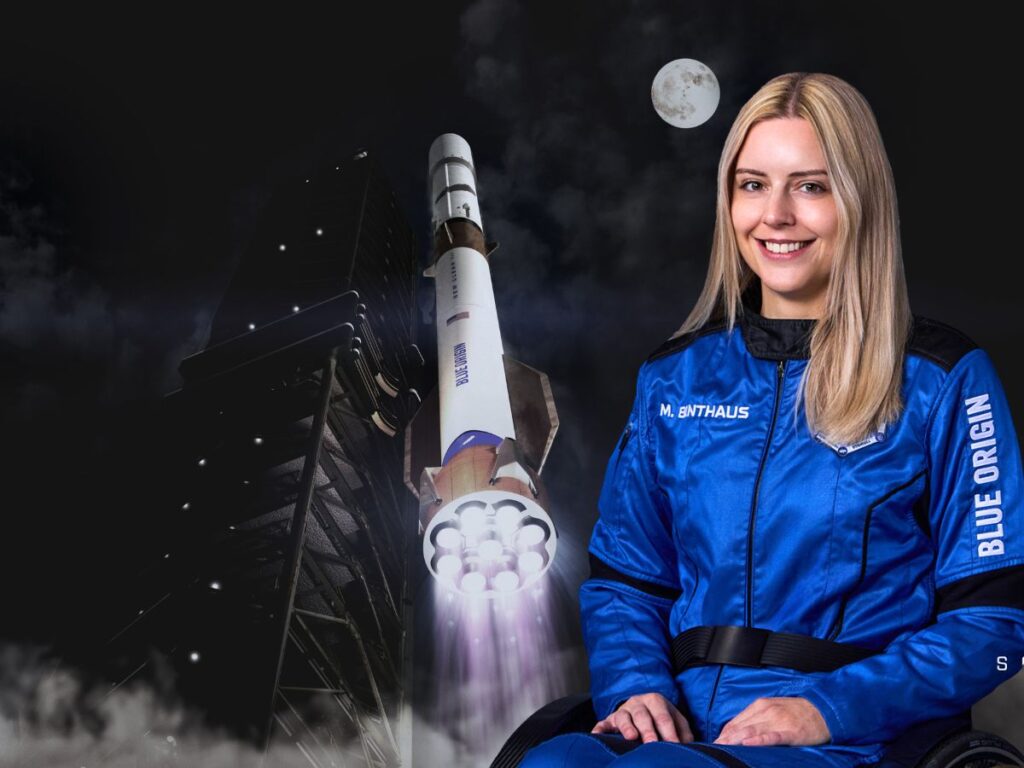
In a groundbreaking moment for space exploration and global inclusion, Michaela Benthaus is set to make history as the first wheelchair user to travel to space. Her journey represents not only a technological and medical milestone but also a powerful statement about accessibility, representation, and the evolving future of human spaceflight.
As space agencies and private spaceflight programs push boundaries beyond Earth, Benthaus’s upcoming mission signals a profound shift—one that recognizes ability in diversity and opens the door for millions of people with disabilities to imagine themselves among the stars.
A Historic First in Human Spaceflight
For decades, human spaceflight was governed by stringent physical requirements designed around a narrow definition of astronaut fitness. While these standards were rooted in safety and engineering limitations, they also excluded individuals with physical disabilities, regardless of skill, intelligence, or resilience.
Michaela Benthaus’s selection challenges that legacy.
Her mission will mark the first time a wheelchair user participates in a spaceflight, redefining what is possible in space exploration and rewriting long-standing assumptions about who can go to space.
Who Is Michaela Benthaus?
Michaela Benthaus is widely recognized as an advocate for disability inclusion and an inspiration within the global accessibility movement. A wheelchair user herself, Benthaus has consistently spoken about the importance of equal opportunity, representation, and adaptive innovation.
Her journey to space is not symbolic alone—it is backed by extensive preparation, collaboration with scientists and engineers, and rigorous evaluations to ensure mission safety and success.
Benthaus’s selection highlights the growing understanding that physical disability does not equate to incapability, especially in environments where technology plays a critical enabling role.
Why This Mission Matters Beyond Space
1. Redefining Astronaut Eligibility
Benthaus’s participation demonstrates that astronaut criteria can evolve alongside technology. Modern spacecraft design, automation, and adaptive systems now allow for a broader range of human bodies to safely operate in space.
This mission challenges outdated medical norms and opens discussions about inclusive astronaut selection frameworks.
2. Advancing Universal Design in Spacecraft
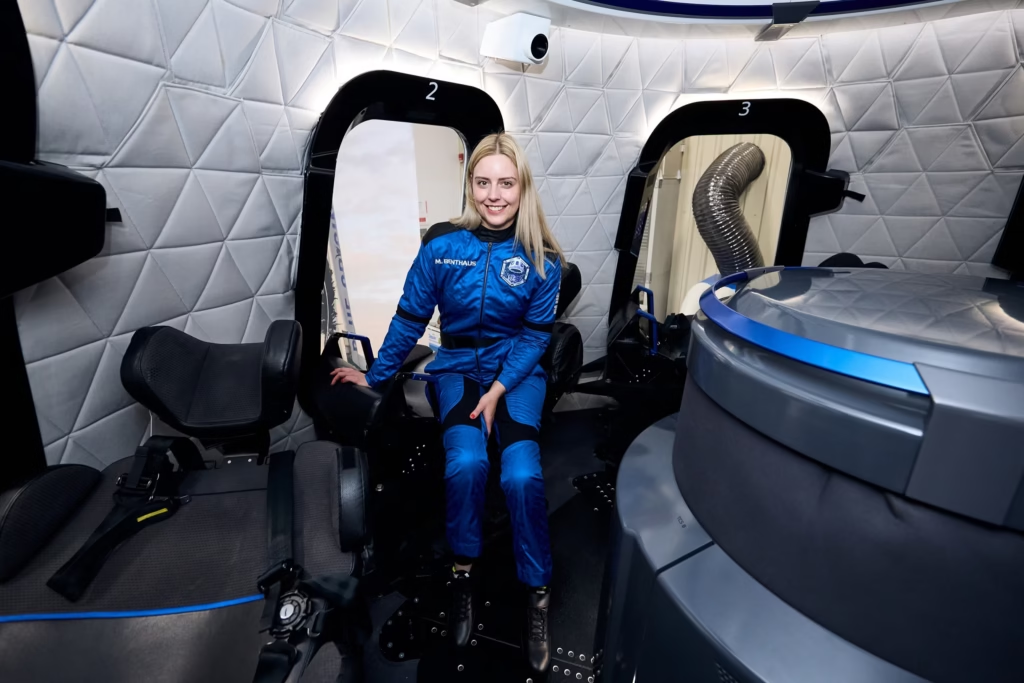
To accommodate a wheelchair user, spacecraft systems must be reimagined with accessibility in mind. This includes:
- Adaptive seating and restraint systems
- Modified mobility solutions for microgravity
- Accessible control interfaces
- Inclusive emergency procedures
These innovations don’t just benefit disabled astronauts—they enhance safety and usability for all crew members.
3. Representation on a Global Scale
For millions of people with disabilities worldwide, seeing a wheelchair user travel to space is a transformative moment. Representation at this level sends a clear message: space belongs to everyone.
This milestone has the potential to inspire:
- Young students with disabilities to pursue STEM careers
- Policymakers to prioritize accessibility in science and technology
- Institutions to rethink inclusion across high-performance fields
Medical and Scientific Preparation
One of the most complex aspects of this historic mission has been the medical and physiological preparation.
Spaceflight places unique demands on the human body, including:
- Fluid shifts
- Muscle and bone density changes
- Cardiovascular adaptation
- Sensory and balance challenges
For a wheelchair user, these factors require additional research and tailored countermeasures. Benthaus has reportedly undergone customized training and medical assessments, contributing valuable data to space medicine and rehabilitation science.
The findings from this mission could benefit:
- Long-duration space missions
- Earth-based rehabilitation therapies
- Aging populations with mobility limitations
Technology Making Inclusion Possible
Benthaus’s mission is only possible because of advances in:
- Spacecraft automation
- Robotics and assisted systems
- AI-supported monitoring
- Ergonomic and adaptive design
Modern spacecraft rely less on manual physical exertion and more on cognitive skill, situational awareness, and decision-making—areas where disability is not a limitation.
This technological evolution is redefining what “astronaut readiness” means in the 21st century.
A Shift in the Culture of Space Exploration
Historically, space exploration emphasized uniformity and standardization. Today, the industry is moving toward human-centered design, acknowledging that diversity strengthens innovation.
Benthaus’s inclusion reflects:
- A cultural shift toward equity and inclusion
- Recognition of lived experience as a form of expertise
- Acceptance that different bodies bring different strengths
This change mirrors broader movements across science, medicine, and engineering that value diverse perspectives.
Global Reactions and Public Response
The announcement of Michaela Benthaus’s space mission has sparked widespread reactions across the world.
Positive Public Response
- Disability rights advocates have hailed it as a historic breakthrough
- Educators see it as a teaching moment for inclusive science
- Space enthusiasts celebrate a new era of exploration
Expert Perspectives
Scientists and engineers note that inclusion drives innovation, forcing systems to become more adaptable, resilient, and user-friendly.
Medical experts emphasize that this mission could reshape how physical fitness and capability are assessed in extreme environments.
Inspiring the Next Generation
Perhaps the most powerful impact of this mission lies in its inspiration.
For children and young adults with disabilities, seeing someone like Michaela Benthaus reach space:
- Expands imagination
- Builds confidence
- Challenges internalized limitations
For society at large, it reinforces the idea that barriers are often systemic—not personal.
Implications for the Future of Space Travel
Benthaus’s mission may influence future policies and programs, including:
- Inclusive astronaut recruitment initiatives
- Accessibility standards for space stations
- Design of lunar and Mars habitats
- Civilian and commercial spaceflight participation
As space travel becomes more frequent and eventually more accessible, inclusion will be essential—not optional.
Disability Inclusion and Human Rights
This milestone also intersects with global human rights conversations. Equal access to scientific advancement is increasingly viewed as a matter of equity and justice.
By enabling a wheelchair user to travel to space, the space community sends a powerful signal: human potential is not defined by physical conformity.
Challenges and Responsibility
While this moment is celebratory, experts caution that inclusion must be genuine and sustained—not symbolic.
True progress requires:
- Continued investment in accessible design
- Policy frameworks that protect equal opportunity
- Long-term commitment to diversity in STEM
Benthaus’s mission sets a precedent, but its legacy will depend on what follows.
Conclusion
Michaela Benthaus’s journey into space marks a historic turning point in human exploration. As the first wheelchair user in space, she is not only breaking physical barriers but also dismantling mental and institutional ones.
Her mission proves that with the right technology, mindset, and commitment, space can truly be a place for everyone. It reminds the world that progress is not just about going farther—but about bringing more people along on the journey.
As humanity looks toward the Moon, Mars, and beyond, Michaela Benthaus’s story will stand as a defining chapter—one that expands not only our reach into space, but our understanding of who belongs there.