
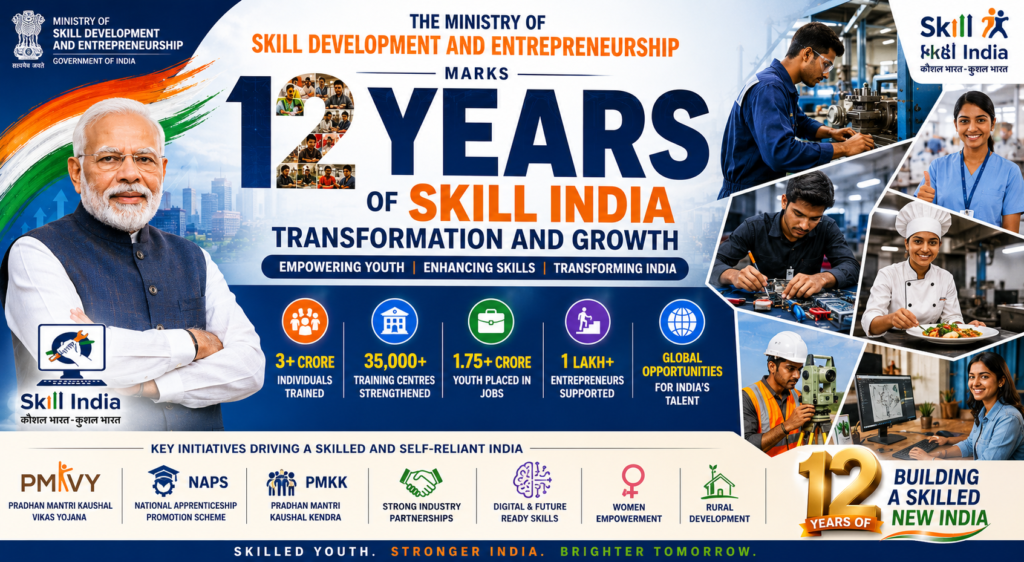
The Ministry of Skill Development and Entrepreneurship (MSDE) has celebrated 12 years of the Skill India Mission, highlighting a decade-plus of transformative efforts aimed at equipping India’s youth with industry-relevant skills, promoting entrepreneurship, and enhancing employability across sectors.
Launched in 2015 under the leadership of Prime Minister Narendra Modi, the Skill India Mission has emerged as one of the country’s most significant human capital development initiatives. Over the years, the program has trained millions of individuals, strengthened vocational education systems, and aligned workforce capabilities with the evolving needs of the economy.
As India aspires to become a global manufacturing and innovation hub, skill development remains a key pillar supporting economic growth, employment generation, and inclusive development.
What is Skill India Mission?
Skill India is a flagship initiative of the Government of India designed to empower the country’s workforce through vocational training, industry partnerships, apprenticeship programs, and entrepreneurship support.
The mission aims to:
- Improve employability among youth
- Bridge skill gaps across industries
- Promote entrepreneurship
- Support economic growth
- Strengthen vocational education
- Enhance workforce competitiveness
The initiative focuses on creating a skilled workforce capable of meeting both domestic and international industry demands.
Key Achievements Over 12 Years
Since its launch, Skill India has achieved significant milestones across various sectors.
Millions Trained Across India
Through various schemes and programs, millions of youth have received training in sectors such as:
- Manufacturing
- Healthcare
- Information Technology
- Construction
- Retail
- Tourism and Hospitality
- Renewable Energy
- Logistics
The training ecosystem has expanded into both urban and rural regions.
Expansion of Skill Development Infrastructure
The government has established and strengthened:
- Industrial Training Institutes (ITIs)
- Skill Development Centers
- Pradhan Mantri Kaushal Kendras (PMKKs)
- National Skill Training Institutes
These institutions have played a critical role in delivering quality skill training nationwide.
Pradhan Mantri Kaushal Vikas Yojana (PMKVY)
One of the flagship programs under Skill India is the Pradhan Mantri Kaushal Vikas Yojana (PMKVY).
The scheme focuses on:
- Short-term skill training
- Recognition of prior learning
- Placement assistance
- Industry-certified courses
PMKVY has helped improve employability and create pathways to formal employment for many young Indians.
National Education Policy and Skill Development
The Skill India Mission has gained additional momentum through integration with the National Education Policy (NEP) 2020.
The policy promotes:
- Vocational education in schools
- Practical learning opportunities
- Industry exposure
- Skill-based curricula
This approach aims to make skill development a mainstream component of India’s education system.
Focus on Apprenticeships
Apprenticeship programs have become a major focus area under Skill India.
Benefits include:
- Hands-on industry experience
- Workplace exposure
- Improved employability
- Industry-ready workforce development
The National Apprenticeship Promotion Scheme (NAPS) has encouraged companies to actively participate in workforce training.
Supporting India’s Manufacturing Growth
Skill development is critical to supporting initiatives such as:
- Make in India
- Digital India
- Startup India
- Atmanirbhar Bharat
A skilled workforce is essential for expanding manufacturing capacity, attracting investments, and enhancing productivity.
As India aims to become a global manufacturing hub, workforce readiness remains a strategic priority.
Entrepreneurship Development
The Ministry has also emphasized entrepreneurship as a driver of economic growth.
Programs focus on:
- Business mentoring
- Startup support
- Financial literacy
- Innovation promotion
- Self-employment opportunities
Entrepreneurship development helps create jobs while encouraging innovation and local economic development.
Digital Skill Development
The rapid growth of technology has increased demand for digital skills.
Recent Skill India initiatives include training in:
- Artificial Intelligence (AI)
- Data Analytics
- Cybersecurity
- Cloud Computing
- Digital Marketing
- Coding and Software Development
Digital skill programs aim to prepare India’s workforce for emerging industries and future job markets.
Women Empowerment Through Skill Development
Women have become major beneficiaries of various skill development programs.
Training initiatives support women’s participation in sectors such as:
- Healthcare
- Beauty and Wellness
- Retail
- Digital Services
- Entrepreneurship
Increasing female workforce participation remains an important objective of India’s economic development strategy.
Rural Skill Development Initiatives
Skill India has expanded significantly into rural areas.
Programs focus on:
- Agricultural value chains
- Rural entrepreneurship
- Traditional crafts
- Livelihood enhancement
These efforts help reduce regional disparities and create local employment opportunities.
International Workforce Opportunities
India’s growing skilled workforce is increasingly finding opportunities in global markets.
Skill development initiatives support training aligned with international standards in sectors including:
- Healthcare
- Construction
- Hospitality
- Information Technology
- Manufacturing
Global mobility partnerships are helping skilled Indian professionals access overseas employment opportunities.
Industry Partnerships
Collaboration with industry remains central to the success of Skill India.
Partnerships help:
- Design industry-relevant curricula
- Improve training quality
- Facilitate placements
- Address emerging skill requirements
Industry participation ensures that training programs remain aligned with market needs.
Emerging Technologies and Future Skills
The future of work is rapidly changing due to technological advancements.
Skill India is increasingly focusing on:
- Artificial Intelligence
- Robotics
- Automation
- Green Technologies
- Semiconductor Manufacturing
- Electric Vehicles
Preparing youth for future industries is critical for maintaining economic competitiveness.
Green Skills and Sustainability
As India expands its renewable energy and sustainability initiatives, green skills have become increasingly important.
Training programs now include:
- Solar technology
- Renewable energy maintenance
- Sustainable construction
- Environmental management
Green jobs are expected to become a significant source of future employment.
Challenges Ahead
Despite substantial progress, several challenges remain.
Skill Gap Mismatch
Some industries continue reporting shortages of skilled workers despite large training programs.
Placement Enhancement
Improving post-training employment outcomes remains a priority.
Rapid Technological Change
Training curricula must continuously evolve to match emerging industry requirements.
Regional Variations
Ensuring uniform skill development opportunities across all states remains important.
Addressing these challenges will be critical for sustaining long-term success.
Vision for the Future
The Ministry of Skill Development and Entrepreneurship aims to further strengthen India’s workforce through:
- Advanced technology training
- Industry partnerships
- Global skill standards
- Digital learning platforms
- Entrepreneurship promotion
The focus remains on creating a future-ready workforce capable of driving India’s economic transformation.
Conclusion
The completion of 12 years of Skill India represents a major milestone in India’s journey toward becoming a skilled, innovative, and globally competitive economy.
Through large-scale training programs, vocational education reforms, entrepreneurship support, and industry collaboration, the Skill India Mission has significantly contributed to workforce development and employment generation.
As India enters a new era of digital transformation, manufacturing expansion, and technological innovation, continued investment in skills and human capital will remain essential for achieving sustainable economic growth and realizing the vision of a developed India by 2047.