
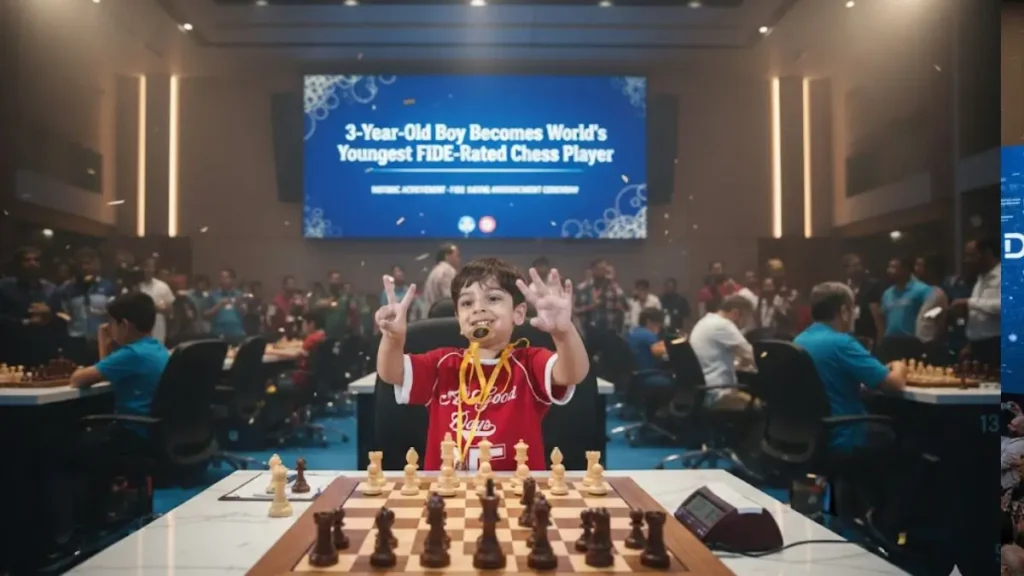
India has once again captured the world’s attention in the realm of chess, as a 3-year-old Indian boy has officially become the world’s youngest FIDE-rated chess player. This extraordinary achievement has not only stunned the international chess community but also reinforced India’s rising dominance in the global chess landscape. At an age when most children are still learning to speak full sentences, this young prodigy has already entered the competitive international chess ranking system.
This historic milestone is a powerful testament to talent, discipline, and the growing strength of India’s grassroots chess ecosystem.
⭐ What Does Becoming a FIDE-Rated Player Mean?
The International Chess Federation (FIDE) is the global governing body of chess. A player becomes officially FIDE-rated only after participating in approved international tournaments and meeting strict performance criteria.
For a child as young as three to achieve this status is almost unprecedented in chess history. It requires:
- Participation in FIDE-recognized tournaments
- Competing against experienced players
- Demonstrating consistent competitive performance
- Earning official rating points
This achievement places the young Indian boy into the global professional chess database, making him officially recognized worldwide.
⭐ A Historic First for India and the World
Until now, the youngest FIDE-rated players across the world were typically aged between 5 and 7 years. Breaking that record at just three years old is nothing short of revolutionary.
This achievement:
- Sets a new global benchmark
- Establishes India as a world leader in child chess development
- Inspires millions of young children and parents worldwide
- Redefines the limits of early childhood learning
It is a moment that will be remembered in chess history for decades to come.
⭐ The Rise of a Chess Prodigy
From a very early age, the child displayed unusual cognitive abilities such as:
- Advanced pattern recognition
- Exceptional memory
- Strong concentration skills
- Fast learning ability
- Tactical awareness
By the age of two, he was already playing structured chess games and solving simple tactical puzzles. His parents and coaches soon realized that this was not ordinary childhood play—but the emergence of rare intellectual talent.
Through consistent training, puzzle-solving, and tournament exposure, his skills progressed at a breathtaking pace.
⭐ Role of Family and Early Coaching
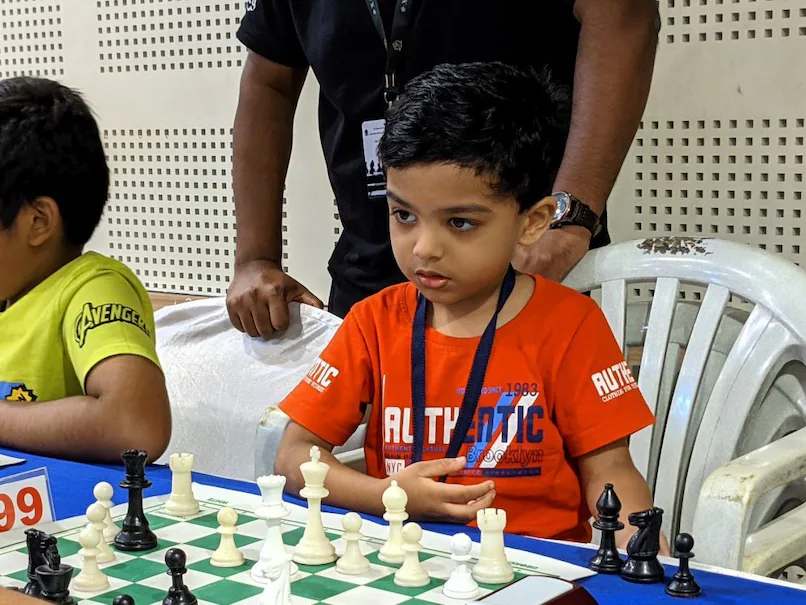
Behind this historic success is the unwavering support of his family. His parents:
- Introduced him to chess as a learning activity
- Ensured playful training instead of pressure
- Focused on discipline balanced with enjoyment
- Encouraged curiosity rather than competition obsession
His coaching team adopted a unique approach:
- Micro-learning sessions
- Visual training tools
- Pattern-based learning
- Short but regular practice schedules
- Emphasis on joy over stress
This method ensured that the child’s natural talent flourished without mental burnout.
⭐ India’s Growing Chess Power
India today is considered one of the most powerful nations in world chess, thanks to:
- Multiple Grandmasters
- Strong junior development programs
- School-level chess integration
- Online chess training platforms
- Affordable access to coaching
This young boy’s achievement is the latest chapter in India’s growing chess revolution. With players excelling at both junior and senior levels, India has become a global chess factory for champions.
⭐ Why Children Are Learning Chess Younger Than Ever
Across the world, chess is now being introduced to children as young as:
- 2 years
- 3 years
- 4 years
Experts say chess helps develop:
- Logical thinking
- Memory power
- Emotional control
- Strategic planning
- Decision-making skills
- Focus and patience
For this young Indian prodigy, chess became a natural extension of playful learning rather than forced academic pressure.
⭐ Challenges of Being a Child Prodigy
While the achievement is inspiring, experts also highlight the challenges involved in guiding child prodigies:
- Mental fatigue
- Social balance
- Emotional pressure
- Risk of early burnout
- High public expectations
Parents and coaches emphasize that protecting the child’s happiness, health, and childhood freedom is more important than chasing titles.
The focus remains on slow, healthy growth rather than rapid commercialization.
⭐ What This Means for the Future of Indian Chess
This achievement signals:
- A stronger future pipeline of Grandmasters
- Earlier entry into professional chess circuits
- Increased global recognition for Indian chess
- Growth in chess academies and youth programs
- Rising international sponsorship interest
If nurtured correctly, this child could become one of the youngest International Masters or Grandmasters in the future.
⭐ Global Reaction to the Achievement
Chess communities worldwide have reacted with:
- Amazement at the early age
- Praise for India’s training ecosystem
- Interest from international chess academies
- Discussion on early childhood learning through chess
Several experts believe this moment represents a new era of ultra-early cognitive training through structured games like chess.
⭐ Technology’s Role in Early Chess Development
Modern technology has made this feat more possible than ever before:
- Interactive chess apps
- AI-powered training tools
- Online video coaching
- Virtual tournaments
- Digital puzzle platforms
These tools allow children to learn chess visually and interactively at an early age, making training engaging rather than rigid.
⭐ A Symbol of India’s Youth Potential
This 3-year-old FIDE-rated player is more than a chess milestone. He represents:
- India’s massive untapped youth talent
- The power of early cognitive development
- The effectiveness of disciplined play-based learning
- The future of competitive sports beginning at early ages
India’s demographic advantage is now translating into global sporting excellence at unprecedented ages.
⭐ Balanced Development Is the Key
While the chess world celebrates this record, experts stress that:
- Education must not be neglected
- Playtime remains essential
- Emotional growth must come first
- Social skills should be protected
- Competitive pressure should be controlled
The child’s guardians have stated that chess will remain a joyful journey and not a burden.
⭐ Conclusion
The rise of a 3-year-old Indian boy as the world’s youngest FIDE-rated chess player is one of the most inspiring sporting stories of the year. It highlights the extraordinary potential of young minds when nurtured with patience, balance, and purpose.
This achievement is not just about records—it is about the future of learning, early talent discovery, and India’s growing influence in intellectual sports. As the child continues his journey, the world will watch with admiration and hope.
A new chapter in chess history has been written—and it begins with India.