
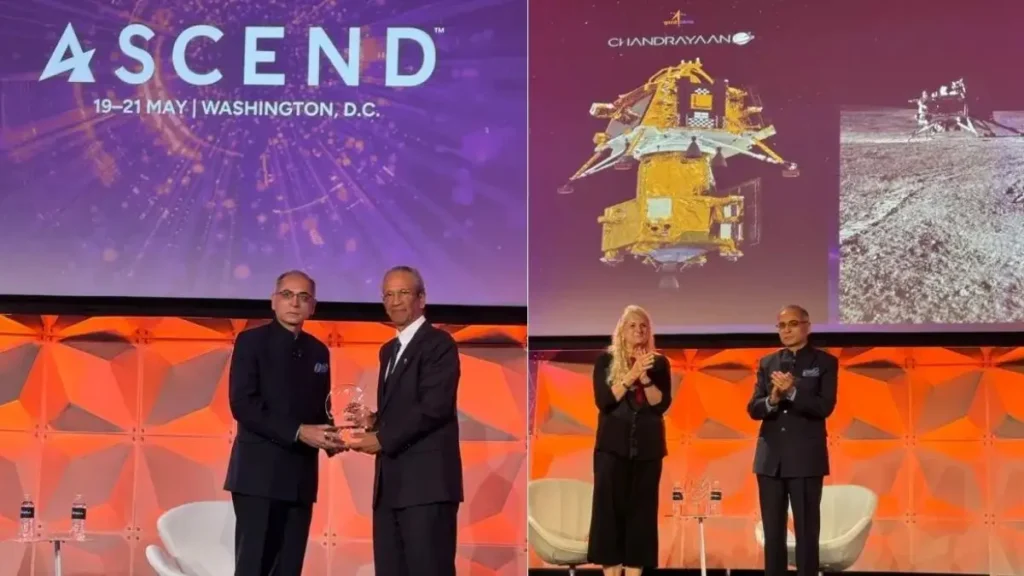
Indian Space Research Organisation (ISRO) has achieved another major global milestone after Chandrayaan-3 received the prestigious 2026 AIAA Goddard Award for its historic lunar mission success.
The award, presented by the American Institute of Aeronautics and Astronautics (AIAA), recognizes exceptional achievements in space science, aerospace engineering, and technological innovation. Chandrayaan-3’s successful soft landing near the Moon’s south pole made India the first country in the world to achieve this feat, earning widespread international recognition.
The achievement is being celebrated as a landmark moment not only for India’s space program but also for the global scientific community.
What Is the AIAA Goddard Award?
The AIAA Goddard Award is among the most respected honors in the global aerospace sector.
Named after rocket pioneer Robert H. Goddard, the award recognizes outstanding accomplishments in:
- Space exploration
- Aerospace innovation
- Scientific research
- Engineering excellence
- Mission success
The award is presented to missions, scientists, engineers, or organizations that significantly advance aerospace technology and space science.
Chandrayaan-3 receiving this recognition highlights the growing global influence of India’s space capabilities.
Why Chandrayaan-3 Made History
Chandrayaan-3 became one of the most important lunar missions in recent history after successfully landing near the Moon’s south polar region in August 2023.
The mission achieved several historic milestones:
- India became the first country to land near the Moon’s south pole
- India became the fourth nation to achieve a successful soft lunar landing
- ISRO demonstrated advanced autonomous landing capabilities
- The mission strengthened India’s global space leadership
The lunar south pole is scientifically important because researchers believe it may contain water ice deposits and valuable geological information.
Significance of the Moon’s South Pole
The Moon’s south pole has become one of the most strategically important areas in modern space exploration.
Scientists are interested in the region because it may support future missions involving:
- Water extraction
- Lunar habitation
- Fuel production
- Deep space exploration
The region’s permanently shadowed craters are believed to contain frozen water molecules, making it critical for future human space missions.
Chandrayaan-3’s success significantly boosted international scientific interest in lunar south pole exploration.
India’s Growing Space Leadership
The award reinforces India’s rapidly growing reputation as a major global space power.
Over the past decade, India has expanded its space capabilities through missions involving:
- Lunar exploration
- Mars missions
- Satellite technology
- Navigation systems
- Commercial space launches
- Human spaceflight preparation
ISRO is increasingly recognized for achieving advanced technological milestones at relatively low costs compared to many international space agencies.
Global Recognition for ISRO
Chandrayaan-3’s success received praise from multiple international space agencies and scientific organizations.
Countries worldwide recognized the mission as a major achievement in:
- Precision engineering
- Space navigation
- Autonomous landing systems
- Scientific innovation
The AIAA award further strengthens ISRO’s international credibility and scientific prestige.
Engineering Excellence Behind Chandrayaan-3
The mission demonstrated remarkable engineering capabilities despite the extreme challenges involved in lunar landing operations.
Key technological achievements included:
Autonomous Landing Systems
The lander used advanced guidance and navigation systems to safely land on the Moon.
Hazard Detection Technology
The spacecraft identified safe landing zones during descent.
Precision Soft Landing
ISRO successfully managed velocity reduction and landing stabilization in a highly complex lunar environment.
Rover Deployment
The Pragyan rover conducted surface experiments and scientific observations after landing.
These achievements contributed significantly to the mission’s international recognition.
Scientific Contributions of Chandrayaan-3
The mission also generated valuable scientific data about the lunar surface and environment.
Experiments focused on:
- Lunar soil composition
- Surface temperature analysis
- Seismic activity studies
- Plasma environment observations
The findings contribute to broader global understanding of lunar geology and planetary science.
Importance for India’s Future Space Missions
The success of Chandrayaan-3 is expected to support India’s future space ambitions.
Upcoming priorities include:
- Gaganyaan human spaceflight mission
- Advanced lunar exploration
- Space station planning
- Deep space research
- International collaborations
The experience gained from Chandrayaan-3 strengthens India’s technical foundation for more ambitious future missions.
Inspiration for Young Scientists
The mission has inspired millions of students and young scientists across India.
Chandrayaan-3 demonstrated how scientific innovation and technological excellence can position India among leading global space nations.
Educational institutions across the country have increasingly promoted interest in:
- Aerospace engineering
- Robotics
- Astronomy
- Artificial Intelligence
- Space science research
The mission’s success has become a source of national pride and scientific inspiration.
Economic and Strategic Importance of Space Technology
Space technology increasingly influences:
- Communication systems
- Navigation
- Weather forecasting
- Defense systems
- Disaster management
- Commercial industries
India’s growing space capabilities may also strengthen its economic and strategic competitiveness globally.
The global space economy is expanding rapidly, creating opportunities for innovation, startups, satellite services, and international partnerships.
India’s Cost-Effective Space Model
One of the most widely praised aspects of ISRO’s missions is cost efficiency.
India has gained global recognition for delivering sophisticated space missions at comparatively lower costs through:
- Efficient engineering
- Indigenous technology development
- Optimized mission planning
This approach has made India an attractive partner in the international space sector.
International Collaboration Opportunities
Following Chandrayaan-3’s success, India’s opportunities for international space cooperation are expected to expand further.
Potential areas include:
- Lunar exploration partnerships
- Satellite launches
- Space research collaborations
- Deep space missions
- Scientific data sharing
India is increasingly becoming an important participant in global space diplomacy and exploration initiatives.
Growing Global Race for Lunar Exploration
The Moon has once again become a major focus of international space programs.
Countries including:
- United States
- China
- Russia
- Japan
- European nations
- India
are actively pursuing lunar exploration missions.
The lunar south pole, in particular, has emerged as a strategic target for future exploration and possible long-term human presence.
Public Pride and National Recognition
Chandrayaan-3’s achievement generated enormous public celebration across India.
The mission became a symbol of:
- Scientific progress
- National innovation
- Technological self-reliance
- Global competitiveness
The AIAA award further reinforces public pride in India’s scientific and engineering communities.
Role of Women Scientists in ISRO
The mission also highlighted the growing role of women scientists and engineers in India’s space sector.
Many women played critical leadership and technical roles in Chandrayaan-3’s planning and execution.
The success has encouraged greater visibility for women in STEM fields including:
- Engineering
- Research
- Aerospace science
- Technology innovation
Future of India’s Space Program
India’s space sector is expected to expand significantly in coming years through:
- Private sector participation
- Space startups
- Satellite manufacturing
- Human spaceflight programs
- International collaborations
Government reforms are also opening new opportunities for commercial space innovation and private investment.
Global Importance of Lunar Research
Lunar exploration is increasingly important for the future of human space exploration.
The Moon may eventually support:
- Scientific bases
- Fuel generation systems
- Deep space mission launch points
Research conducted through missions like Chandrayaan-3 contributes to the broader global effort to understand and utilize extraterrestrial environments.
Conclusion
Chandrayaan-3 winning the prestigious 2026 AIAA Goddard Award marks another historic achievement for India’s space program and reinforces ISRO’s growing global leadership in space exploration.
The mission’s successful landing near the Moon’s south pole demonstrated India’s advanced technological capabilities, scientific innovation, and engineering excellence on the global stage.
As India continues expanding its space ambitions, Chandrayaan-3’s success and international recognition are expected to inspire future generations while strengthening the country’s position in the rapidly evolving global space economy.