
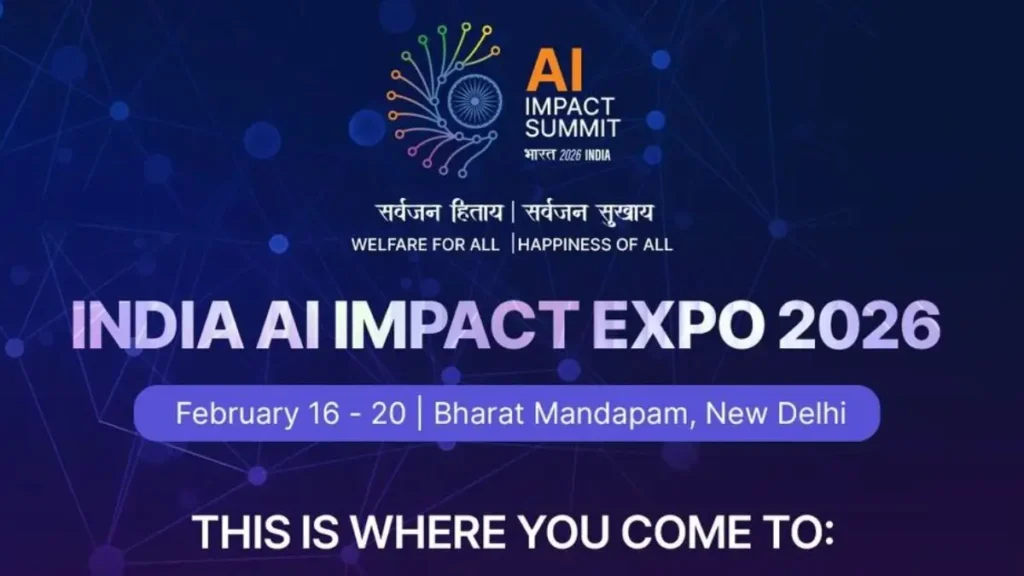
India is set to host the landmark India–AI Impact Summit 2026, the first global AI summit ever held in the Global South, bringing together world leaders, tech CEOs, researchers, startups and policymakers to debate how artificial intelligence can be harnessed responsibly for people, planet and progress.
Taking place as a five-day programme at the newly developed Bharat Mandapam in New Delhi, the summit (16–20 February 2026) combines high-level policy discussions with an expansive expo showcasing AI solutions aimed at social good and economic inclusion. The event is anchored on three foundational “Sutras” — People, Planet, Progress — and organised into multiple thematic “Chakras” that focus deliberations and working groups across priority areas.
Why this summit matters — a Global South perspective
For decades the global conversation about AI — regulations, standards, investment flows, and research agendas — has been dominated by high-income countries. Hosting the AI Impact Summit in India signals a structural shift: countries from the Global South will be center stage to shape norms, set priorities and showcase scalable, low-cost AI solutions tailored to emerging-market needs such as agriculture, healthcare, education and financial inclusion. This repositioning aims to reduce tech-colonial dynamics by ensuring that policies and funding models reflect the realities of two-thirds of the world’s population.
The summit’s emphasis on equitable, outcome-driven AI is more than symbolic. It creates a practical platform for sharing solutions that are computationally efficient, accessible offline, and designed for constrained infrastructure — attributes essential for real-world impact across low- and middle-income countries.
High-profile participation and global attention
The India–AI Impact Summit has drawn major global figures from technology, philanthropy and geopolitics. Prime Minister Narendra Modi is slated to inaugurate the AI Impact Expo, underscoring the government’s strategic priority on AI as an engine for economic transformation.
Top industry leaders — including Sundar Pichai, Sam Altman and other CEOs — are expected to participate in panels and plenaries, offering a rare gathering where corporate research heads and public-sector policymakers can exchange views and coordinate on standards, compute access and investment. Such cross-sector interaction increases the likelihood of concrete partnership announcements, funding commitments and shared initiatives that prioritize public good outcomes.
International endorsement has been strong. United Nations Secretary-General António Guterres publicly welcomed India’s role as host, framing the summit as an opportunity to align AI with sustainable development objectives. That kind of multilateral backing helps channel global attention (and resources) toward responsible, inclusive AI.
Flagship initiatives: challenges, expo and youth focus
A central pillar of the summit is a set of Global Impact Challenges designed to surface AI solutions with demonstrable social benefit. These include:
- AI for ALL — solutions across agriculture, healthcare, education, climate resilience and more.
- AI by HER — a dedicated track to scale women-led AI innovations.
- YUVAi — a youth-focused challenge inviting innovators aged 13–21.
Together these challenges attracted thousands of applications from dozens of countries, and finalists will get mentorship, cloud/compute credits, investor connects and travel support to present at the summit. The aim is to convert prototypes into widely adopted, scalable deployments.
Alongside the challenges, the India AI Impact Expo spans thematic pavilions, government showcases, private-sector exhibits and live demonstrations — a curated marketplace to discover solutions that can be rapidly piloted in public systems and scaled across regions. The expo’s scale (hundreds of exhibitors from dozens of countries) signals a maturation: AI is no longer an abstract debate topic, but a toolbox for governments and enterprises.
What to watch for — key outcomes investors, policymakers and practitioners want
- Policy frameworks for responsible AI — expect commitments to interoperable standards, data-governance practices, and cross-border cooperation on safety and transparency. The Global South voice could push for regulations that balance innovation with safeguards tailored to local contexts rather than transplanting one-size-fits-all rules.
- Compute and data partnerships — India’s convening power may unlock new public-private models for affordable cloud credits, shared datasets for public good, and partnerships that democratize access to compute for startups and research labs in emerging markets.
- Funding and accelerator announcements — with CEOs, VCs and philanthropic actors present, the summit is fertile ground for investment commitments into impact-oriented AI ventures, post-summit accelerators, and country-level deployment funds.
- Scale-ready solutions for basic services — look for pilot agreements in health screening, drought prediction, low-cost diagnostics, and education tech that can be adopted by state and national governments.
- Talent and capacity-building programs — initiatives to train thousands of practitioners and regulators in responsible AI methods could emerge, addressing the skills gap that constrains safe deployment at scale.
Challenges ahead — and why expectations should be tempered
Hosting a global summit is necessary but not sufficient. Translating dialogue into durable impact will require:
- Clear roadmaps and measurable KPIs for pilot-to-scale transitions.
- Funding vehicles that accept lower risk-return profiles typical of public-good technologies.
- Continuous engagement across ministries, states, and local governments to embed AI into public services responsibly.
- Stronger safeguards against algorithmic bias and misuse, especially in policing, welfare delivery and credit decisions.
The India summit can catalyze action — but sustained follow-through, multi-lateral financing, and local capacity building are essential to convert commitments into tangible improvements for citizens.
What this means for India and the Global South
For India, hosting the summit is more than prestige: it signals leadership in defining the next era of technology diplomacy. It positions India as a convenor that can bridge advanced research labs, large tech platforms, and a vast, diverse set of real-world problem settings where AI can deliver measurable social benefit. The Global South as a whole gains an institutional platform to advocate for inclusive standards, share home-grown innovations, and attract investments oriented toward public-good outcomes.
Conclusion
The India–AI Impact Summit 2026 represents a pivotal moment — a concrete effort to rebalance the global AI narrative toward inclusivity, practicality and public welfare. With a program that mixes policy, expo showcases, global challenges and youth engagement, the summit aims to turn AI rhetoric into implementable solutions that work for billions outside high-income tech hubs. Success will depend on follow-through: whether investments, partnerships and regulatory innovations born at the summit translate into scaled deployments that improve livelihoods, protect the planet, and advance shared progress.